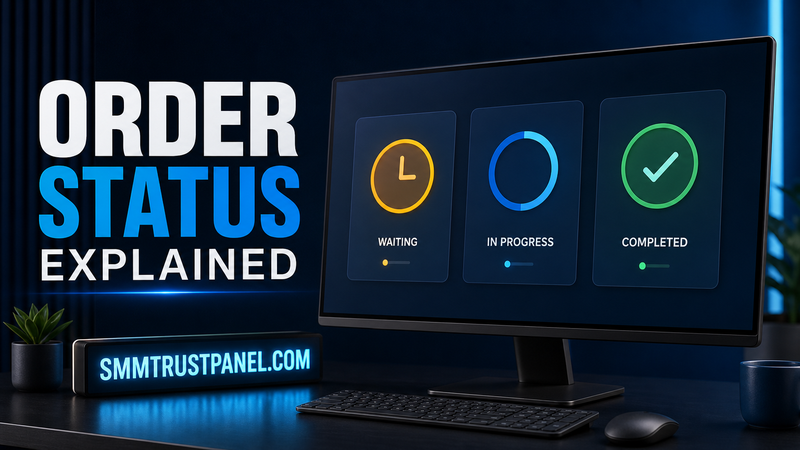
An SMM panel order status tells you where an order sits in the delivery workflow; it does not, by itself, prove audience quality, permanent retention, or marketing success. If your order is pending, appears stuck in progress, or finishes as partial, the useful next step is to check the order record before placing another order or assuming a refund is due.
This guide explains common status labels, the difference between delivery and refill requests, and a practical way to document an issue. It is written for direct users, freelancers, agencies, and resellers, including teams in Nepal working with customers elsewhere. You can use the workflow alongside the SMM panel dashboard and the pre-order quality checklist.
Summary
Pending generally means an order is waiting for a later processing step. Processing or in progress commonly indicates that work has begun or the order has entered an active workflow. Completed reports that the provider has closed delivery, while partial usually means the full requested quantity was not fulfilled. Labels and transitions vary by service, so the specific order record and service terms take priority over a generic definition.
Use three pieces of evidence together: the status, the recorded quantities, and the account or content you actually ordered for. Keep payment questions separate from delivery questions, and treat a refill request as a separate process. If these records disagree, request clarification with the order ID rather than trying to resolve uncertainty by buying more.
Why understanding order status prevents expensive mistakes
A status label can change what you should do next. A waiting order may need monitoring, a partial order may need reconciliation, and a completed order with a discrepancy may need investigation. Treating all three as the same problem creates confusion for both the customer and support team.
For an agency, the cost is not limited to the original charge. There is also staff time spent checking accounts, answering messages, reconciling balances, and explaining an inaccurate client update. A small, well-maintained order log can prevent the same issue from being investigated twice by different team members.
For a reseller, the distinction between your customer's order number and the supplier's order number is particularly important. Two systems may update at different times. Record the relationship between those references so a support request identifies the correct transaction without exposing another customer's information.
Before deciding that an order is late, revisit the relevant service description. Compare the actual situation with what was offered, not with a delivery promise you inferred from a different service or an old screenshot.
Common SMM panel order statuses and what to check
The following table is a general reading guide, not a promise that every service uses every label. A dashboard may skip stages, use different wording, or require support to explain an unusual transition.
| Status or message | Common interpretation | Sensible next step |
|---|---|---|
| Pending | Recorded but waiting for a later workflow step | Check submission time, target link, and service instructions |
| Processing | Accepted into a processing workflow | Monitor the existing order; do not assume visible delivery has started |
| In progress | Delivery is active or reported as underway | Compare status and quantity records at sensible intervals |
| Completed | Provider reports the delivery workflow is finished | Reconcile the record and investigate any discrepancy |
| Partial | Only part of the requested quantity was fulfilled | Check remaining quantity, charge, and any balance adjustment |
| Canceled | The order has been stopped or closed without normal completion | Verify the actual delivery and account adjustment |
| Error or failed request | A submission or lookup encountered a problem | Establish whether an order exists before retrying |
Pending is a queue signal, not a diagnosis
A pending label does not explain why an order is waiting. Possible questions include whether the submission was accepted, whether the link is valid, or whether the service is available. Only the order details or support response can establish the reason for your particular case.
Write down the submitted time and the stated start estimate. If you cannot find an estimate, do not invent a universal waiting period. Ask what applies to the selected service. Repeatedly refreshing the page gives you another observation, but it does not create new evidence about the underlying cause.
Processing and in progress are not identical to visible results
An order can enter a processing stage before you observe a change on the target page. Conversely, a visible count can move while the dashboard still shows an older value. Avoid making a firm conclusion from one screen at one moment.
Record both observations with timestamps. For example, write that the dashboard showed in progress at a particular time and that the public count was unchanged when checked. This is more useful than telling support that the entire system is broken.
Completed describes the order, not your business outcome
A completed label is a delivery statement from the provider. It is not proof that an audience will buy, that a post will rank, or that a platform will approve monetization. Those are different outcomes with different evidence requirements.
If a completed order appears inconsistent with your records, preserve the original link and gather the order ID, quantity, baseline, and current observation. Do not immediately delete the content, change the username, or submit an overlapping order to make the visible total look right.
Partial needs reconciliation before replacement
A partial status calls for checking what was ordered, what was recorded as delivered, and what remains unresolved. It should not automatically trigger a second order for the original full quantity. Doing that can leave you with more spending and less clarity.
Consult the refund and cancellation policy for account-specific handling. The published page contains both general restrictions and a partial-order FAQ, so ask support to clarify your case when those sections leave uncertainty. This guide does not create a new refund entitlement or override the policy.
An error message is not always an order outcome
A browser timeout, connection problem, or failed lookup is different from an explicit order rejection. The first question is whether the system recorded an order at all. Look for an order ID and a matching history entry before pressing submit again.
If you cannot establish what happened, preserve the error text and contact support. Do not send passwords or API secrets with that message. The public API documentation can help an integration developer distinguish order creation from status retrieval.
Read quantities without confusing them with audience quality
The documented status response includes fields such as charge, start count, status, remains, and currency. These fields help reconcile a transaction; they are not a complete audit of the people or activity behind a public metric. Check what each field means for the particular service before building reports around it.
It helps to keep three separate columns in your own notes: requested quantity, provider-reported delivery, and your observed change. Combining them into one number makes it harder to see whether a disagreement concerns measurement, timing, or the order itself.
An illustrative remaining-quantity calculation
Suppose an example order requests 1,000 units and the record shows 250 remaining. If that service defines remaining as the undelivered part of the requested quantity, the implied delivered quantity is:
1,000 requested − 250 remaining = 750 reported delivered.
The corresponding reported completion proportion is 750 divided by 1,000, or 75%. These numbers are illustrative, not a current offer, invoice, or guarantee. They also do not demonstrate that 750 genuine customers interacted with a business.
Use the calculation as a consistency check. If the definition of a field is unclear, ask before treating the result as settled. A service using different units or counting rules may require a different interpretation.
Why the public count may not match simple subtraction
Your public total may change for reasons unrelated to the order you are checking. Other marketing activity, ordinary audience behavior, and changes in what the platform counts can complicate attribution. A visible difference between two screenshots is therefore an observation, not automatic proof of supplier delivery.
The reverse is also true: an unchanged public total does not identify the cause of a delivery problem. Record what you can verify and avoid inventing an explanation. Keep your own observations separate from any explanation subsequently confirmed by support.
A step-by-step workflow for an order that appears stuck
Use this sequence before opening multiple tickets or replacing the order. It creates a concise evidence trail and reduces the risk of making the original issue harder to investigate.
Step 1: Locate the exact order
Open your order history and match the service, target, quantity, and approximate submission time. Do not rely on the service name alone; two orders can use the same service for different posts. Save the order ID where the person handling support can find it.
If you are working through a reseller dashboard, confirm which reference belongs to the customer-facing system and which belongs to the supplier. Label them clearly instead of assuming that one number works everywhere.
Step 2: Check the target without changing it
Open the submitted URL and confirm that it points to the intended account or content. Look for obvious differences such as a different post, an unavailable page, or a username that has changed. Document any change and when it happened.
Avoid changing privacy settings repeatedly as an experiment. First compare the target with the service's documented requirements. If the original input was wrong, be direct about that when seeking help; hiding the change delays an accurate assessment.
Step 3: Re-read the original service conditions
Compare the order against the description that applied when you bought it, if you saved a copy. Check the allowed quantity, expected start, target format, refill conditions, and any instruction about overlapping orders. The order quality checklist explains what to capture before a future purchase.
Do not transfer conditions between services simply because they have similar names. A refill-enabled listing and a no-refill listing may require different actions after a decrease. Ask about your exact service rather than requesting a general promise for the entire catalog.
Step 4: Compare timestamps consistently
Write timestamps with a timezone. A customer in Nepal and an overseas supplier may describe the same event using different calendar times. Recording both the local observation and its timezone prevents an avoidable argument about how long the order has been waiting.
Use one time basis when calculating elapsed time. Do not subtract a dashboard timestamp from a phone screenshot until you know which timezone each uses. This is an administrative check, not a prediction of when delivery will finish.
Step 5: Record the evidence and ask one clear question
Collect the current status, quantity, relevant screenshots, and target URL. State the discrepancy in one sentence. Then ask for a specific clarification, such as whether the order is still active or whether a displayed charge is final.
Use the site's contact options if you need help finding the correct support route. Continue an existing relevant conversation when possible so the evidence and previous response remain together.
Step 6: Verify the resolution
After support responds, check the actual order record and any account adjustment. A message saying an issue has been escalated is not the same as a confirmed resolution. Record what changed and what, if anything, remains open.
For client work, update the customer with the verified outcome rather than forwarding an unqualified promise. If support requests another check later, record that next action in your own task list instead of leaving it in an unread message.
Delivery, cancellation, refill, and refunds are separate workflows
These processes can relate to the same order without meaning the same thing. An order status describes fulfillment. A cancellation asks to stop an order where possible. A refill concerns an eligible later decrease. A refund or balance adjustment concerns accounting. Check each relevant record rather than treating one status as proof of all four.
SMM Trust Panel's published terms describe delivery times as estimates and do not promise permanent retention. That is why a completed order should not be presented to a client as a permanent result.
For cancellation, availability depends on the order and applicable conditions; submitting a request does not establish that it was accepted. For a refill, check eligibility and the separate request outcome. For refunds, distinguish a credit to panel balance from a reversal to the original payment method. Confirm the actual adjustment rather than assuming where money went.
When policy pages appear inconsistent, preserve your evidence and ask for written clarification through support. Avoid turning a generic blog explanation into a promise about an individual order. The policy page remains the place to review the published conditions.
How agencies and resellers should report an unresolved order
A useful client update separates three statements: what you observed, what has been confirmed, and what you will do next. For example, an illustrative update could say: “The supplier record is still in progress. We have asked support to explain the unchanged quantity. We will send another update after receiving a response.”
That wording does not invent an estimated completion time. It also does not pretend that contacting support has already fixed the issue. If you later receive a confirmed explanation, update the client and retain the earlier record for context.
Maintain a simple reconciliation table for your team:
| Record | What to store | Why it matters |
|---|---|---|
| Customer reference | Your internal job or invoice reference | Connects the work to the right customer |
| Supplier reference | The panel order ID | Identifies the exact delivery record |
| Target and service | URL and service identifier | Prevents investigation of the wrong order |
| Timing | Submission and observation times with timezone | Makes elapsed-time comparisons consistent |
| Status evidence | Current label and relevant quantities | Supports a specific question |
| Accounting | Original charge and confirmed adjustments | Separates delivery from payment reconciliation |
| Next action | Owner, question, and follow-up point | Prevents duplicated work |
This is a suggested internal record, not a claim that every column exists in the panel. Store only the information your team needs, restrict access appropriately, and never put passwords or full API keys in a shared client report.
Budgeting for support time and unresolved orders
The cheapest listed rate is not necessarily the lowest operational cost for a reseller. Two services with similar prices can create different workloads if their descriptions, records, and support requirements differ. Evaluate those differences using your own documented experience, not unverified claims about provider quality.
Consider a hypothetical job with a service cost of 8 accounting units. If it also requires 20 minutes of staff work valued internally at 12 units per hour, the staff-time allocation is 4 units. The combined illustrative operational cost is 12 units before any other overhead. This is not a service price, recommended selling price, tax calculation, or projected profit.
The example shows why you should track support effort as well as the order charge. Do not erase an unresolved cost from your records simply because a refund has been requested. Record an adjustment when it is confirmed and reconcile it against the actual account history.
If you are selecting a future service, compare the current catalog, its conditions, and your own monitoring capacity. Buying a larger quantity is not a remedy for an unexplained previous order.
Panel records and official platform analytics answer different questions
A panel reports its own order workflow. Official platform analytics describe activity measured under the platform's systems. Neither should be renamed as the other in a client report. Keep supplier-reported quantities, platform-reported activity, and business results in clearly labeled sections.
There are also policy risks beyond delivery. For example, YouTube's fake engagement policy prohibits artificial increases in engagement metrics and warns that violations can affect content or channels, including when someone else is hired to promote them. An order marked completed does not make prohibited activity acceptable or establish eligibility for monetization.
Use official advertising tools when you need an advertising campaign and evaluate it with the relevant campaign measurements. Use content and community work for genuine audience development. Do not describe a third-party metric order as an official ad purchase, or claim that its status proves improved organic reach, lower advertising costs, or sales.
Common mistakes that make troubleshooting harder
Ordering again before identifying what happened
A second submission can create a second problem while the first remains unclear. The practical fix is to check history and establish whether the original order exists. For integration work, ask the developer to reconcile an uncertain response instead of blindly resending the purchase request.
Using screenshots without context
A cropped number without an order ID, target, or timestamp is difficult to interpret. Keep a clear internal record, then share the minimum necessary evidence with support. Remove unrelated customer information, account balances, and private messages before sending screenshots outside your team.
Treating an estimate as a guaranteed deadline
Plan your customer communication around uncertainty rather than promising completion at the edge of a quoted average. Leave room for investigation. If a deadline is business-critical, evaluate whether the service is appropriate before committing your customer's campaign to it.
Mixing a delivery issue with a later decrease
“It never arrived” and “the total decreased after completion” are different reports. Document which event occurred and when. Use the service FAQs for orientation, then check the conditions attached to the exact order before deciding which request to submit.
Measuring success only by the order counter
An administrative completion rate is not a customer acquisition rate. Keep enquiries, qualified visits, sales, and other business outcomes separate. If those results are absent, do not claim success merely because a supplier marked the order complete.
Practical recommendations for different users
For a beginner, the priority is a manageable record: save the order ID, link, description, and submission time. Learn how the history page reports an order before committing to work you cannot monitor. Ask questions early when the description is ambiguous.
For a freelancer, agree on what you will report to the client before ordering. Distinguish your own service fee from the supplier charge where appropriate, and be honest about the origin and limitations of any purchased activity. Never promise genuine customers or lasting results based on a label.
For an agency, assign one owner to each exception. That person should maintain the evidence, contact support, and update the client. A second reviewer can check the final reconciliation without opening a competing ticket or placing another order.
For a reseller using an integration, review the API reference with your developer. The documented order ID and status functions provide a basis for reconciliation, but the surrounding recordkeeping and error handling still need thoughtful implementation.
For teams serving Nepal and international customers, confirm the currency used in the order record and write down the timezone used for communication. Do not infer local payment availability or country-targeted delivery simply from the customer's location.
What better order monitoring should look like
A useful direction for future workflow improvements is clearer evidence, not more aggressive purchasing. Teams can prioritize consistent timestamps, traceable order references, and explicit separation between an unresolved request and a confirmed outcome. These are practical design goals, not predictions or announcements of upcoming SMM Trust Panel features.
Automated reminders may help an operator notice an unresolved order, but automation should not decide that every delay requires replacement. A careful process should pause uncertain purchases for review and keep client updates tied to verified records. Better reporting means fewer unsupported assumptions, even when the underlying service is unchanged.
Key takeaways
- An SMM panel status describes a workflow, not guaranteed marketing success.
- Check the exact order ID and target before diagnosing a delay.
- Pending does not identify the reason an order is waiting.
- Completed does not prove permanent retention or genuine customer interest.
- Reconcile a partial order before considering any replacement.
- Separate delivery, refill, cancellation, and balance adjustments in your records.
- Review the current terms rather than relying on assumptions.
- Use the pre-order checklist to collect better evidence next time.
- Share clear timestamps and quantities, never passwords or API secrets.
Conclusion
Understanding SMM panel order status is mainly about making the next decision with better evidence. Read the status alongside the service conditions, quantity records, and target observations. When the records disagree, document the issue and ask a specific question before spending more.
Use SMM Trust Panel to review your existing order records, and consult the relevant support and policy pages when you need clarification. A disciplined monitoring process cannot guarantee delivery or business results, but it can help you avoid duplicate actions, communicate honestly, and keep your accounts easier to reconcile.
Frequently asked questions
Why is my SMM panel order still pending?
Pending generally means the order is waiting for a later workflow step, but the label does not establish the cause. Check the submitted time, target URL, and service instructions. If the applicable estimate has passed or details are unclear, ask support about the exact order ID.
Does in progress mean delivery is visible already?
Not necessarily. It reports an active stage in the provider's workflow, which may not match your latest observation of the public count. Record both the dashboard state and the target observation with timestamps before drawing a conclusion.
What should I do when an order is partial?
Reconcile the requested quantity, remaining quantity, charge, and any confirmed adjustment before placing another order. Review the refund policy and ask support for clarification where the published conditions do not clearly resolve your case.
Does completed mean the results are permanent?
No. Completed reports that the delivery workflow has finished; it is not a permanent-retention guarantee or evidence of sales, rankings, or monetization eligibility. Any later decrease needs to be evaluated separately under the applicable service conditions.
Is a refill request the same as a new order?
No. A refill concerns an eligible decrease associated with an earlier order, whereas a new order is a separate purchase. Check the original service terms and the refill request's own outcome rather than assuming either process replaces the other.
Should I retry an order after a connection error?
Only after establishing whether the first submission created an order. Check your history and any returned order ID. If the result remains uncertain, ask support or your integration developer to investigate before resubmitting and risking a duplicate charge.
What information should I send to support?
Send the order ID, service identifier, target URL, current status, relevant quantities, and timestamps with timezone. Include a short description of the discrepancy and relevant screenshots with unrelated private information removed. The contact page provides the site's public support route.