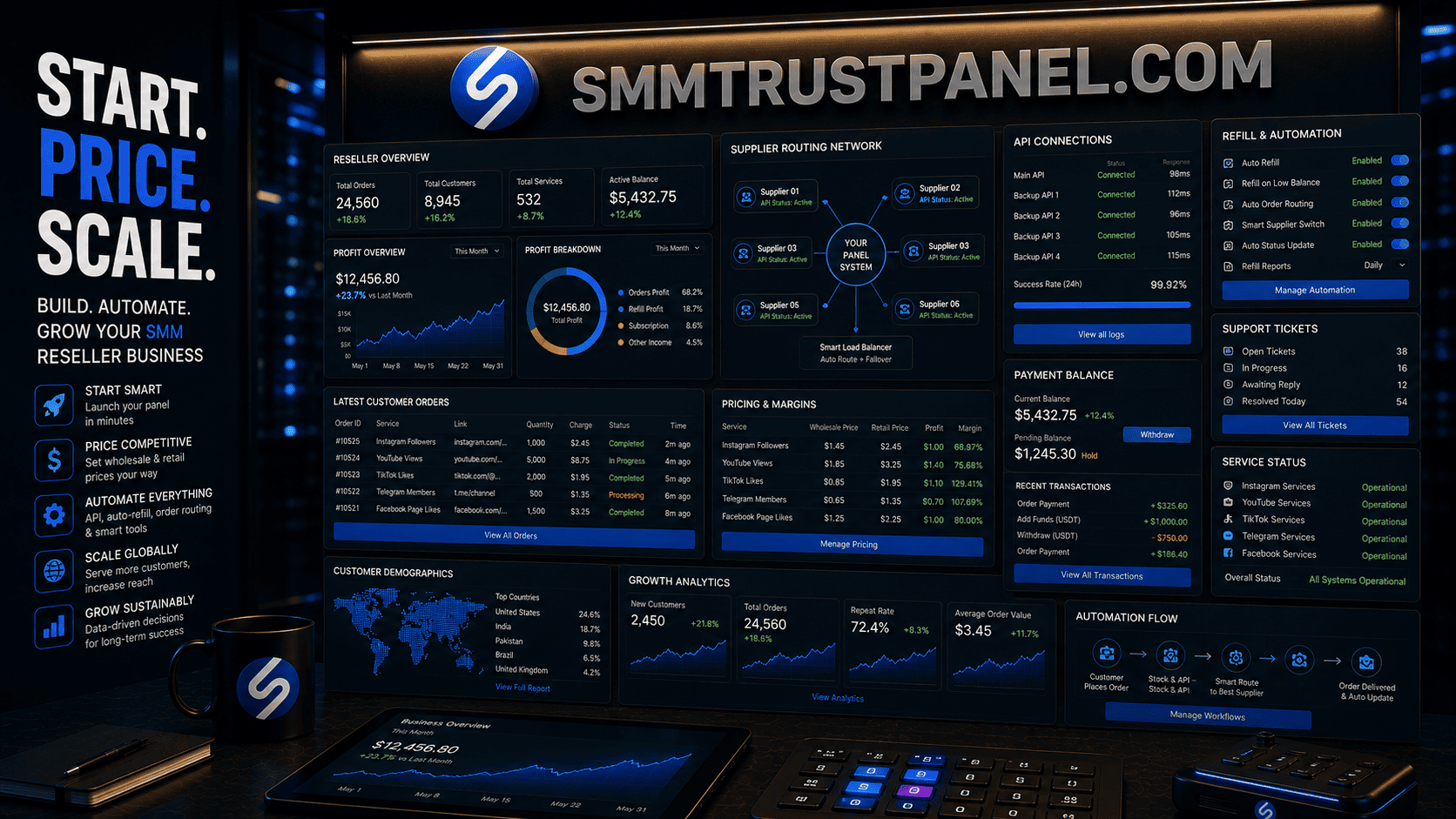
An SMM panel reseller business allows you to sell social media services to your own customers without building the complete delivery infrastructure yourself. You create a retail brand, set your own prices, collect customer payments, and forward orders to an upstream supplier that handles fulfillment.
The model can be used by freelancers, marketing agencies, website owners, and entrepreneurs who want to offer followers, likes, views, subscribers, channel members, post engagement, and other defined social media services through one storefront.
A reseller may place orders manually through an Smm panel or connect a website to the supplier through an API. The difference between a weak reseller business and a scalable one usually comes down to supplier selection, service testing, pricing discipline, customer support, and honest expectations.
The Best smm panel for a reseller is not necessarily the provider with the largest catalogue or the lowest advertised rates. A useful supplier should offer clear service descriptions, dependable order records, usable support, stable API access, and enough pricing room for the reseller to cover payment fees, advertising, refunds, staff time, and profit.
This guide explains how an SMM reseller panel works, how to choose wholesale suppliers, how to calculate prices, how API automation operates, and how to scale without creating unnecessary support problems. It also explains how SMM Trust Panel can support direct users, agencies, and resellers who need centralized fulfillment.
Summary
An SMM reseller buys social media services at wholesale rates and sells them to customers at retail prices. The upstream supplier fulfills the order, while the reseller manages branding, marketing, payments, customer communication, and refunds.
A reseller business can begin with manual ordering and a small service catalogue. As sales increase, the business can use API automation, order validation, support templates, supplier monitoring, and separate retail packages for different customer groups.
Profit is not simply the difference between the wholesale and retail price. A realistic pricing model must include:
Supplier cost
Payment-processing fees
Currency-conversion costs
Advertising or acquisition cost
Customer-support expense
Refund and refill risk
Hosting and software costs
Taxes or legal obligations
Desired net profit
A wholesale SMM service provider can simplify fulfillment, but it cannot guarantee that every service will remain stable forever. Resellers should test individual service IDs, monitor performance, and avoid promising organic growth, permanent retention, monetization, sales, or platform approval.
Why the SMM Reseller Model Attracts Entrepreneurs
Starting a traditional digital agency can require designers, media buyers, content writers, developers, salespeople, and account managers. An SMM reseller business can be launched with fewer resources because the core fulfillment is outsourced.
This creates several advantages.
Low Initial Infrastructure Requirements
The reseller usually does not need to build a follower network, traffic system, or delivery platform.
The main requirements are often:
A domain and website
A panel or order-management system
A supplier account
Payment methods
Customer support
Clear service descriptions
A marketing plan
Access to Multiple Platforms
One supplier may offer services for Instagram, TikTok, YouTube, Facebook, Telegram, X, Spotify, Twitch, LinkedIn, and other platforms.
This allows a reseller to serve several customer types through one dashboard.
Flexible Business Models
A reseller can operate as:
A self-service SMM panel
A managed social media service
A white-label agency
A wholesale supplier to smaller resellers
A niche platform specialist
A regional provider
An API-based fulfillment business
Adjustable Retail Pricing
The reseller can set different markups according to:
Service quality
Customer type
Order volume
Support level
Payment method
Country
Delivery urgency
Refill coverage
Recurring Customer Potential
Agencies, musicians, creators, resellers, and online businesses may place repeated orders when the service is suitable and the support experience is reliable.
However, recurring sales are not guaranteed. Customers can switch suppliers quickly when prices, delivery, or support become inconsistent.
What Is an SMM Reseller Panel?
An SMM reseller panel is a website or dashboard through which a business resells social media services supplied by another provider.
Common keyword variations include:
SMM panel reseller
Reseller SMM panel
SMM panel for reseller
SMM panel for resellers
SMM reseller panel
Social media reseller panel
Wholesale SMM panel
Supplier SMM panel
SMM supplier
SMM reseller panels
SMM reseller panel services
SMM resell
These phrases generally describe the same commercial model, although the level of control can differ.
Direct Reseller
A direct reseller buys services from a supplier and manually submits each customer order.
This model is suitable when:
Order volume is low
The reseller is testing the market
The retail service is managed personally
Automation is not yet necessary
API Reseller
An API reseller connects a retail panel to an upstream supplier.
Customer orders can be forwarded automatically, and order statuses may update without manual work.
This model is useful when:
Daily order volume is high
Customers expect instant ordering
The service catalogue contains many items
The reseller wants to operate continuously
White-Label Reseller
A white-label reseller sells services under a separate brand without prominently showing the upstream supplier.
The reseller controls:
Brand name
Domain
Retail prices
Service descriptions
Customer communication
Marketing
Support policies
The supplier controls fulfillment.
Sub-Reseller or Wholesale Reseller
A successful reseller may later provide services to smaller agencies or panel owners.
At this level, the business functions as a wholesale SMM panel, even if it still purchases certain services from larger upstream suppliers.
Supplier, Reseller, and Retail Customer Roles
The SMM supply chain can contain several layers.
| Role | Main responsibility | Revenue source | Main risk |
|---|---|---|---|
| Service source | Generates or controls delivery | Wholesale fulfillment | Platform changes and service stability |
| Primary supplier | Combines and routes services | Wholesale margin | Supplier dependency |
| Reseller panel | Sells under its own brand | Retail or wholesale markup | Support and refunds |
| Agency | Bundles services with marketing work | Service fees and retainers | Client expectations |
| Retail customer | Purchases the final service | Not applicable | Service suitability |
The phrase main supplier of SMM services can be misleading because there is no single universal supplier behind the entire industry.
A panel may:
Own some service sources
Resell services from other panels
Route orders between several providers
Use different suppliers for each platform
Change sources without changing the service name
For that reason, a supplier should be judged by tested performance rather than by claims of being the original or main provider.
A supplier SMM panel may provide reliable fulfillment for specific services while still relying on external routes for other categories.
How an SMM Panel Reseller Business Works
The basic workflow is straightforward.
Customer Places an Order
The customer chooses a service, submits a public profile or content link, enters a quantity, and pays the retail price.
Reseller Validates the Order
The reseller or software checks:
Correct link format
Public target visibility
Minimum quantity
Maximum quantity
Customer balance
Service availability
Order Goes to the Supplier
The reseller submits the order manually or sends it through an API.
Supplier Processes Fulfillment
The supplier begins delivery according to the selected service conditions.
Status Returns to the Reseller
The order may show:
Pending
Processing
In progress
Completed
Partial
Canceled
Refilling
Reseller Handles the Customer
The reseller remains responsible for:
Explaining delays
Processing refunds
Submitting refill requests
Correcting invalid links
Answering questions
Updating service descriptions
The supplier may fulfill the order, but the retail customer normally sees the reseller as the responsible business.
How to Start an SMM Reseller Panel Business
Choose a Target Market
Avoid trying to serve everyone on the first day.
Possible target markets include:
Individual creators
Music artists
Influencers
Local businesses
Digital agencies
Freelancers
E-commerce stores
SMM resellers
Crypto communities
Gaming creators
Regional customers
A focused market makes it easier to choose services, prices, payment methods, and marketing messages.
For example, a music-focused panel may prioritize:
YouTube views
Spotify activity
SoundCloud plays
TikTok views
Instagram engagement
A B2B reseller may prioritize API access, wholesale pricing, bulk ordering, and fast support.
Choose a Business Model
Decide whether the business will be:
Low-price self-service panel
Premium managed service
Agency add-on
Country-specific reseller
Wholesale API supplier
Platform-specific specialist
A cheap automated panel and a managed premium agency require different pricing and support systems.
Select a Brand and Domain
Choose a brand name that is:
Easy to spell
Easy to remember
Relevant to digital services
Available as a suitable domain
Not confusingly similar to a major platform
Flexible enough for future expansion
Avoid pretending to be officially affiliated with Instagram, Meta, YouTube, TikTok, or another platform.
Set Up the Website
A basic reseller website should include:
Homepage
Service catalogue
Registration and login
Add-funds page
Order form
Order history
Support tickets
Terms of service
Privacy policy
Refund policy
Contact information
The website should work properly on mobile because many customers place orders from phones.
Choose Payment Methods
Payment availability strongly affects conversion.
Depending on the market, customers may expect:
Credit or debit cards
Bank transfers
Mobile wallets
Cryptocurrency
Regional payment gateways
Manual deposits
Review payment fees, settlement times, fraud risk, chargeback exposure, and currency conversion.
Select an Upstream Supplier
Open an account with a provider that offers the services needed for the chosen market.
A reseller using SMM Trust Panel can access several platform categories through one dashboard, but each individual service should still be tested.
Create a Small Initial Catalogue
Do not copy thousands of supplier services immediately.
Start with a manageable list, such as:
Instagram followers
Instagram likes
Instagram Reel views
TikTok followers
TikTok views
YouTube subscribers
YouTube views
Facebook followers
Telegram members
A smaller tested catalogue is easier to support.
Write Clear Service Descriptions
Every retail listing should explain:
Platform
Target type
Minimum quantity
Maximum quantity
Estimated start
Estimated delivery speed
Refill availability
Geographic source
Important limitations
Do not copy unclear supplier names without rewriting them for retail customers.
Test the Complete Checkout Process
Place test orders before launching.
Check:
Registration
Payment
Balance updates
Order submission
API forwarding
Status changes
Email notifications
Ticket creation
Mobile usability
How to Choose the Best SMM Reseller Panel
The best SMM reseller panel is the supplier that supports the reseller’s business model with acceptable quality, pricing, support, and automation.
Test Individual Services
One supplier may have strong Instagram views but weak YouTube subscribers.
Test services separately instead of assuming that one good order proves the complete catalogue is reliable.
Record:
Service ID
Starting count
Start time
Completion time
Delivered quantity
Drop rate
Refill result
Support response
Compare Service Stability
A stable service is often more valuable than a cheaper service that frequently becomes unavailable.
Monitor:
Price changes
Description changes
Delivery delays
Cancellation rates
Refill performance
Service replacements
Review API Quality
An API should provide clear methods for:
Listing services
Creating orders
Checking status
Checking balance
Requesting refills
Canceling eligible orders
Documentation should be understandable enough for a developer to integrate without guessing.
Evaluate Support
Support quality affects the reseller’s reputation.
A suitable supplier should respond to:
Stuck orders
Partials
Cancellations
Refills
Invalid links
API problems
Payment issues
Compare Total Cost
The cheapest wholesale rate may not produce the highest profit.
A service with frequent failures can increase:
Refunds
Customer complaints
Staff workload
Payment disputes
Advertising waste
The Cheapest smm panel provides real value only when low pricing is combined with dependable fulfillment.
API Integration and Automation
API automation allows the reseller website to communicate with the supplier automatically.
Typical API Workflow
The customer submits an order.
The reseller platform validates the request.
The API sends the order to the supplier.
The supplier returns an order ID.
The reseller system stores the ID.
Status checks run automatically.
The retail order updates when the supplier status changes.
Benefits of API Automation
Automation can reduce:
Manual order entry
Human typing errors
Delayed submission
Repetitive status checks
Staff workload
It also allows orders to be placed outside normal working hours.
Risks of Full Automation
Automation can forward bad orders quickly.
Examples include:
Incorrect links
Private profiles
Quantities outside limits
Duplicate orders
Unsupported targets
Services that recently changed
A reseller should use validation rules and alerts rather than forwarding everything without checks.
Supplier Switching
Advanced resellers may connect more than one supplier.
This allows them to:
Compare prices
Replace unavailable services
Route orders by performance
Maintain backup options
Reduce dependency on one provider
However, running several suppliers on the same target simultaneously can cause overdelivery and refill disputes.
How to Price SMM Reseller Services
Pricing should protect the business from costs that are easy to overlook.
Basic Pricing Formula
A practical formula is:
Retail price = Supplier cost + payment cost + support cost + risk reserve + marketing cost + profit
Suppose a service costs $2 per 1,000 units.
The reseller estimates:
Supplier cost: $2.00
Payment fee: $0.20
Support and operating cost: $0.30
Refund or refill reserve: $0.25
Marketing cost allocation: $0.75
Desired profit: $1.50
The retail price becomes:
$2.00 + $0.20 + $0.30 + $0.25 + $0.75 + $1.50 = $5.00
The gross difference between supplier and retail price is $3, but the estimated profit is only $1.50 after the other costs.
Markup Versus Margin
Markup and margin are not the same.
If a service costs $4 and is sold for $6:
Profit before other costs: $2
Markup: $2 ÷ $4 = 50%
Gross margin: $2 ÷ $6 = 33.3%
Confusing markup with margin can cause pricing errors.
Different Prices for Different Customers
A reseller may create:
Retail pricing
Agency pricing
Reseller pricing
High-volume pricing
Managed-service pricing
Wholesale customers usually expect lower prices because they order more frequently and handle their own retail support.
Avoid Automatic Price Multipliers
A fixed 2× multiplier may work for one service and fail for another.
A low-cost view service may support a larger markup, while an expensive country-targeted service may require a smaller percentage.
Use Minimum Profits
Very cheap services can create small absolute profits.
If a service costs $0.05 and is sold for $0.08, a 60% markup still produces only $0.03 before fees.
Use a minimum retail charge where appropriate.
Bulk Followers and High-Volume Services
Keywords such as bulk SMM followers, bulk follows, bulkfollow, bulk follow, and bulkfollows usually reflect demand for high-volume services or wholesale suppliers.
These phrases may also resemble existing service names or brands, so buyers should evaluate the actual provider rather than assuming every similarly named platform is connected.
Bulk orders can be useful for:
Large reseller demand
Multi-account campaigns
Agency fulfillment
Country-specific packages
High-volume customer contracts
They also create greater risks:
Larger refunds
Longer delivery times
Bigger drops
Supplier capacity limits
More visible inconsistencies
Payment exposure
Before accepting a bulk order:
Test the service.
Confirm current capacity.
Review daily delivery limits.
Check refill terms.
Divide the order where appropriate.
Explain realistic timing to the customer.
A bulk social media supplier can make volume fulfillment easier, but the reseller should not promise unlimited capacity without confirmation.
Building a Profitable Service Catalogue
A large service list can look impressive while creating poor usability.
Organize Services by Platform
Use clear categories such as:
Instagram
TikTok
YouTube
Facebook
Telegram
X
Spotify
Twitch
LinkedIn
Create Quality Tiers
Possible tiers include:
Economy
Standard
Premium
Country-targeted
Refill-enabled
Gradual delivery
Explain the actual differences instead of relying only on labels.
Remove Unstable Services
Pause a service when it develops:
High cancellation rates
Long delays
Frequent drops
Refill failures
Repeated complaints
Continuing to sell a broken service can cost more than temporarily losing sales.
Avoid Duplicate Listings
Several nearly identical services confuse buyers.
Keep only the options that serve a clear purpose.
Monitor Profit by Service
A high-revenue service may still be unprofitable if it creates many refunds and tickets.
Track:
Revenue
Supplier cost
Refunds
Payment fees
Support time
Net profit
Customer Support, Refills, Partials, and Cancellations
Support is one of the main differences between a temporary reseller and a sustainable business.
Pending Orders
A pending order has not started.
Possible causes include:
Supplier queue
Invalid target
Temporary maintenance
Capacity limits
Partial Orders
A partial order delivers only part of the requested quantity.
The unused amount is usually returned according to the supplier’s system.
The reseller should explain the completed and refunded quantities clearly.
Canceled Orders
A canceled order may result from:
Private target
Incorrect link
Deleted content
Unsupported target
Supplier failure
Duplicate order
Refill Requests
A refill replaces eligible drops during a specified period.
Refill conditions may require:
Completed order status
Minimum drop
Public target
Unchanged username
No competing supplier orders
Submission within the refill period
Do not advertise “lifetime refill” unless the supplier genuinely supports it and the terms are clear.
Support Templates
Create reusable templates for:
Order pending
Incorrect link
Partial refund
Refill submitted
Service unavailable
Delivery delay
Payment verification
Templates improve speed, but replies should still address the customer’s specific issue.
Security and Operational Controls
An SMM reseller handles customer accounts, balances, payments, and order records.
Protect the Admin Account
Use:
Strong passwords
Two-factor authentication
Limited staff permissions
Regular access reviews
Secure backups
Protect API Credentials
API keys should not be placed in public code or shared with customers.
Replace credentials if they are exposed.
Avoid Requesting Social Passwords
Most public-link services should not require a customer’s social media password, email password, OTP, session cookie, or recovery code.
Validate Customer Links
Automatic validation can reduce:
Invalid orders
Private targets
Wrong platform links
Deleted posts
Unsupported URLs
Keep Financial Records
Track:
Deposits
Supplier spending
Customer balances
Refunds
Payment fees
Chargebacks
Profit
A reseller can show strong sales while losing money through untracked costs.
Honest Marketing, Policies, and Legal Risk
Resellers should describe services accurately.
Avoid claims such as:
Guaranteed organic followers
Guaranteed sales
Guaranteed monetization
Guaranteed verification
Guaranteed viral reach
Permanent followers
Risk-free results
Guaranteed platform approval
Marketing claims should match the service that is actually delivered.
For U.S.-facing operations, the FTC guidance on fake indicators of social media influence is relevant when services could be used to misrepresent a person’s or business’s influence. Other countries may apply different advertising, consumer-protection, tax, privacy, or e-commerce rules.
Resellers should also avoid selling:
Fabricated customer reviews
Fake testimonials
Ad-clicking activity
Guaranteed revenue traffic
Stolen accounts
Credential-based services
Impersonation services
Deceptive political engagement
A terms page does not automatically remove legal responsibility for misleading advertising. Obtain appropriate professional advice for the countries in which the business operates.
How to Market an SMM Reseller Business
Search Engine Content
Publish useful articles answering questions about:
Service types
Delivery speed
Refill policies
Platform differences
Reseller pricing
Account preparation
Campaign limitations
Educational content can attract customers with clearer expectations.
Paid Advertising
Advertising availability may be limited because some platforms restrict promotion of engagement-related services.
Review each advertising network’s current rules before spending money.
Affiliate Programs
Affiliates can send customers in exchange for a commission.
Track:
New registrations
First deposits
Repeat orders
Refund rates
Net value
Agency Partnerships
Freelancers and agencies may need a reliable fulfillment partner.
Offer:
Volume rates
Faster support
API access
Custom packages
Account managers where practical
Local and Regional Marketing
Regional resellers can support:
Local payment methods
Native-language support
Local currencies
Country-targeted services
Regional business hours
Customers searching for an Indian SMM reseller panel may prioritize Indian payment methods and local support, while customers using a Pakistan smm panel may expect payment and service options suited to Pakistan alongside worldwide delivery.
Retention Marketing
Acquiring a customer is only the first step.
Encourage repeat business through:
Reliable support
Clear service updates
Loyalty pricing
Deposit bonuses
Useful account notifications
Tested service recommendations
Avoid sending excessive promotional messages.
How to Scale an SMM Reseller Panel
Scaling should improve efficiency, not multiply existing problems.
Standardize Before Expanding
Document:
Supplier-selection rules
Service-testing process
Pricing formula
Refund rules
Refill procedure
Support escalation
Service-removal criteria
Add Backup Suppliers
One supplier outage should not stop the complete business.
Test backup services before they are needed.
Automate Repetitive Work
Automation can help with:
Order forwarding
Status updates
Low-balance alerts
Service synchronization
Price updates
Ticket routing
Payment confirmation
Hire Support Carefully
Support staff need training on:
Order statuses
Target requirements
Refill rules
Refund calculations
Platform differences
Security
Segment Customers
Separate:
Retail users
Agencies
High-volume resellers
Managed-service clients
Each group can receive suitable prices and support levels.
Monitor Supplier Dependence
If most revenue depends on one service or supplier, the business is vulnerable.
Diversify carefully without adding untested products.
Metrics Every Reseller Should Track
Track business performance through measurable indicators.
Gross Revenue
Total customer payments before costs.
Supplier Cost
Total amount paid for fulfillment.
Gross Profit
Revenue minus supplier cost.
Net Profit
Revenue minus supplier cost, fees, refunds, advertising, payroll, hosting, and other expenses.
Average Order Value
Total revenue divided by the number of orders.
Customer Acquisition Cost
Marketing cost divided by the number of new paying customers.
Repeat Purchase Rate
The percentage of customers who order again.
Refund Rate
Refunded value divided by total sales.
Cancellation Rate
Canceled orders divided by total orders.
Ticket Rate
Support tickets divided by orders.
Service Failure Rate
Orders that cancel, partial, or require significant support.
A reseller should scale services with healthy profit and manageable support demand, not merely high order volume.
Common Mistakes to Avoid
Copying the Supplier Catalogue Without Testing
A large untested catalogue creates confusion and support problems.
Start with a smaller reliable selection.
Competing Only on Price
There will almost always be another seller offering a lower rate.
Compete through:
Clarity
Support
Payment convenience
Service testing
Better descriptions
Reliable order handling
Ignoring Payment Fees
Small transaction costs can remove much of the profit from low-value orders.
Promising Guaranteed Results
A reseller cannot control organic reach, sales, verification, monetization, or permanent retention.
Depending on One Supplier
A service outage can stop the entire business.
Maintain tested alternatives.
Automating Bad Services
Automation increases the speed of both good and bad fulfillment.
Test before routing large order volumes.
Accepting Large Orders Without Capacity Checks
Confirm supplier limits before accepting a major customer payment.
Hiding Service Limitations
Unclear terms create disputes and chargebacks.
Confusing Revenue With Profit
High sales do not guarantee a profitable business.
Neglecting Customer Support
Poor communication can damage trust even when the supplier eventually completes the order.
Expert Recommendations
Begin With Ten to Twenty Tested Services
A focused catalogue is easier to price, market, and support.
Use Separate Retail and Wholesale Pricing
Retail buyers and resellers have different needs.
Maintain a Service Performance Sheet
Record:
Service ID
Supplier
Cost
Start time
Speed
Drop rate
Refill quality
Customer complaints
Net margin
Keep a Refund Reserve
Do not withdraw every payment as profit.
Maintain funds for:
Cancellations
Chargebacks
Supplier changes
Payment disputes
Technical problems
Review Prices Regularly
Supplier rates and payment costs can change.
Update retail prices before margins disappear.
Build Trust Through Clear Communication
Tell customers:
What the service delivers
What it does not guarantee
Expected timing
Refill conditions
Link requirements
Use SMM Trust Panel as Infrastructure, Not a Promise
SMM Trust Panel can support order fulfillment, service access, and reseller operations. The reseller must still manage branding, customers, profitability, and truthful marketing.
Future Trends in SMM Reselling
Smarter Supplier Routing
Panels may increasingly route orders automatically according to price, speed, availability, and historical performance.
Better Link Validation
Automatic systems may detect private profiles, deleted posts, and incorrect platform links before orders are submitted.
More Detailed Service Analytics
Resellers may receive clearer data on:
Average start time
Completion rate
Refill history
Failure rate
Customer profitability
Greater Demand for Regional Payments
Local payment options and currencies will remain important for country-focused resellers.
More Managed-Service Packages
Customers may prefer complete packages that combine content advice, account preparation, and selected SMM services.
Stronger Platform Enforcement
Low-quality routes may become less stable as social platforms improve spam and inauthentic-engagement detection.
Greater Emphasis on Transparency
Professional resellers will increasingly separate panel-delivered metrics from organic marketing, advertising, and genuine customer behavior.
More Specialized Reseller Brands
Rather than offering every possible service, some businesses may specialize in music, video, messaging platforms, local businesses, or agency fulfillment.
Key Takeaways
An SMM panel reseller sells services from an upstream supplier under its own brand and pricing.
A Smm panel can provide fulfillment infrastructure, but the reseller manages customers, payments, and support.
The main supplier of SMM services is not always visible, because many panels use several upstream routes.
The Best smm panel for resellers should offer clear descriptions, stable API access, usable support, and room for profit.
Wholesale price is only one cost; payment fees, refunds, marketing, and support must be included.
A smaller tested catalogue is usually more manageable than thousands of unverified services.
Bulk orders should be accepted only after confirming supplier capacity and delivery limits.
The Cheapest smm panel is valuable only when low rates are combined with reliability.
Resellers should avoid deceptive claims about organic growth, monetization, permanent retention, or guaranteed sales.
SMM Trust Panel can support businesses that test carefully, price realistically, and maintain clear customer policies.
Conclusion
An SMM panel reseller business can be started with relatively limited infrastructure because the reseller does not need to build every delivery source personally.
The business model is simple: purchase services at wholesale rates, sell them at retail prices, and manage the customer relationship. The difficult part is building reliable operations around that process.
A successful reseller must choose suppliers carefully, test individual services, calculate real margins, protect customer balances, manage support, and maintain backup options. Copying a catalogue and adding a markup is not enough.
A professional Smm panel can provide services, API access, order tracking, and wholesale fulfillment. It cannot guarantee that every route will remain unchanged or that customers will receive organic growth, sales, monetization, or permanent results.
SMM Trust Panel provides worldwide users, agencies, and resellers with centralized access to social media services. Resellers can begin manually, test the market, and add automation as order volume grows.
Whether you are building an international platform, an Indian SMM reseller panel, or a Pakistan smm panel, long-term growth depends on the same principles: accurate descriptions, realistic prices, tested suppliers, strong support, and honest expectations.
Frequently Asked Questions
What is an SMM reseller panel?
An SMM reseller panel is a website or dashboard that allows a business to resell social media services supplied by an upstream provider.
How much money is needed to start an SMM panel?
The required budget depends on the software, domain, hosting, supplier deposit, payment setup, and marketing plan. A small manual reseller can start more cheaply than a fully automated platform.
How does an SMM panel API work?
The API sends customer orders from the reseller website to the supplier automatically and returns order IDs, statuses, balances, and other supported information.
How should an SMM reseller price services?
Add supplier cost, payment fees, support expense, refund risk, marketing cost, operating expenses, and desired profit. Do not use one fixed markup for every service.
What is the best SMM reseller panel?
The best option offers suitable wholesale prices, stable services, clear descriptions, API access, refill tools, and responsive support. A Best smm panel should still be tested service by service.
Can an SMM reseller panel guarantee permanent followers?
No. Followers, likes, views, and other metrics can drop because accounts leave, close, or are removed. Review refill terms instead of promising permanent retention.
Is an SMM reseller business profitable?
It can be profitable when pricing covers supplier costs, payment fees, advertising, refunds, support, and operations. High revenue alone does not guarantee profit.
Can SMM Trust Panel be used by resellers?
Yes. SMM Trust Panel can provide centralized service access for direct users, agencies, and resellers. Each service should be tested before it is added to a retail catalogue.