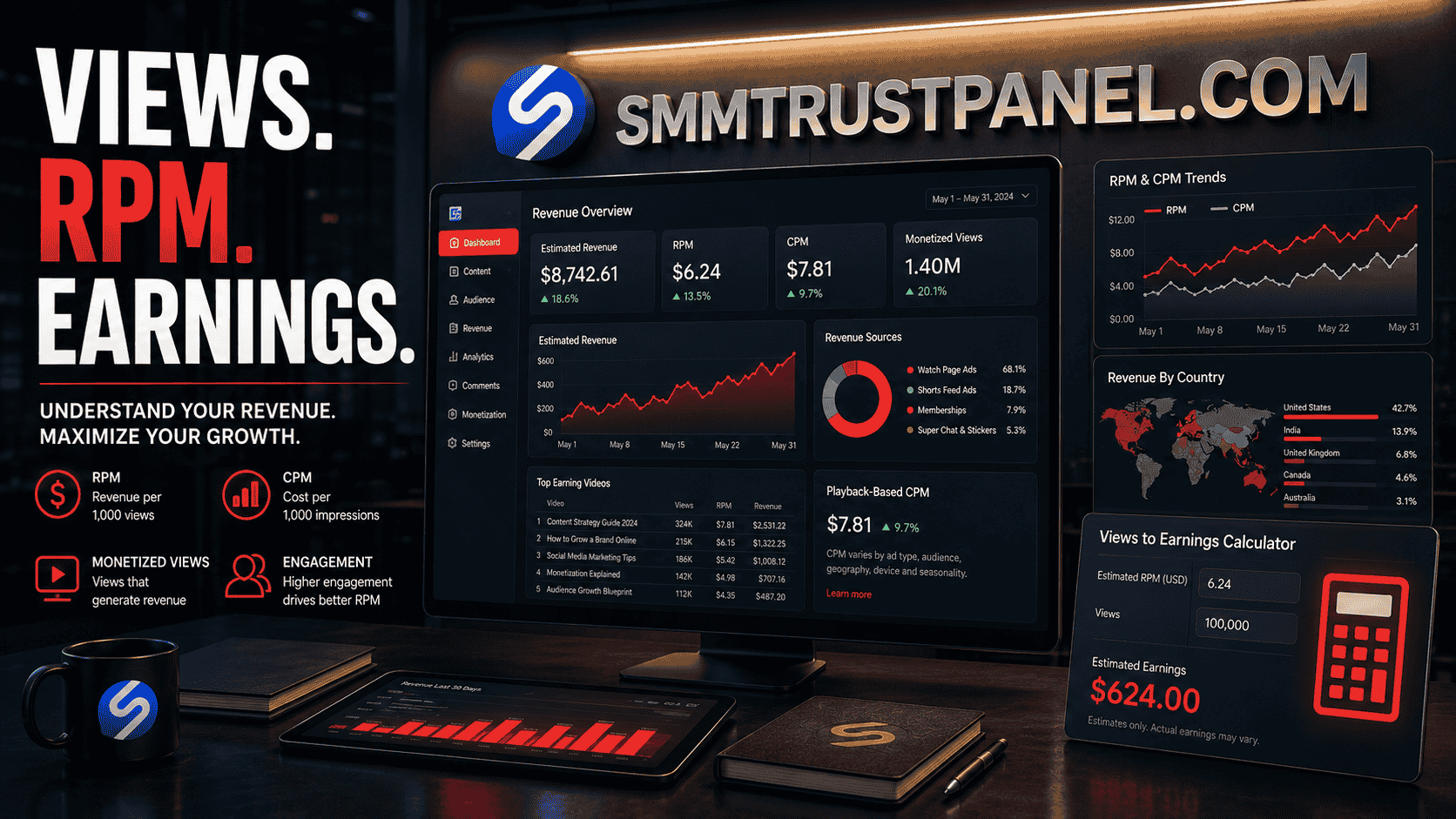
YouTube pay per view is not a fixed amount that every creator receives whenever somebody opens a video. YouTube earnings depend on whether the channel is monetized, whether an advertisement is shown, the viewer’s location, the content category, advertiser demand, video length and several other factors. A creator may receive no advertising revenue from one view and significantly more from another, which is why earnings are normally measured per 1,000 views rather than as a guaranteed payment for each individual view.
People asking how much do YouTubers make per view are usually trying to understand whether a channel can become a reliable source of income. The realistic answer is that views create earning opportunities, but views alone do not determine revenue. Creators also need eligible content, access to the YouTube Partner Program, advertiser-friendly videos and an audience attractive to advertisers.
For creators and agencies using a Smm panel, it is important to separate social proof from monetization. Views, subscribers and engagement may support the public presentation of a channel, but purchased or artificial traffic should never be treated as a method for generating advertising income. A reputable Best smm panel should be used for suitable marketing objectives, while genuine viewers, original content and policy compliance remain essential for YouTube revenue.
This guide explains how YouTube payments work, the difference between RPM and CPM, how much YouTube may pay per 1,000 views, why earnings vary between countries and niches, and how creators can build a more sustainable revenue strategy. It also explains where services from SMM Trust Panel may fit into broader channel marketing without confusing promotional metrics with genuine monetized traffic.
Summary
YouTube does not publish one universal payment rate for every view. The amount a creator earns is normally evaluated through RPM, or revenue per 1,000 views. If a channel has an RPM of $3, for example, it earns approximately $3 for every 1,000 total views included in that calculation. That equals an average of $0.003 per view, but it does not mean YouTube literally pays $0.003 whenever an individual watches the video.
The answer to how much does YouTube pay per 1000 views depends on the audience, country, niche, season, monetized playback rate, advertising demand and additional revenue sources. YouTube earnings per 1,000 views may also include income from YouTube Premium, memberships, Super Chat, Super Stickers and other eligible features, depending on the creator’s analytics and channel setup.
Subscribers and likes are not paid at a fixed rate. They can indirectly improve reach, audience loyalty and future views, but YouTube does not normally pay a creator simply because someone subscribes or likes a video. Creators considering a Cheapest smm panel should therefore use services for proportionate promotion or social proof rather than expecting purchased metrics to generate direct advertising payments.
Why YouTube Earnings Matter to Creators and Marketers
YouTube earnings matter because they influence how creators plan content, choose topics, evaluate audiences and build sustainable businesses. A video with one million views may generate a different amount from another video with the same view count because the two videos may attract different advertisers, countries, formats and viewing behavior.
Understanding youtube revenue per view also helps prevent unrealistic expectations. New creators sometimes believe that every view has a fixed cash value. Others assume that a large subscriber count automatically guarantees high income. In reality, a smaller channel with a valuable audience and strong monetization can earn more than a much larger channel whose views produce limited advertiser demand.
For agencies and resellers, accurate information improves customer communication. A client may ask whether ordering views through a social media services panel will generate YouTube ad income. The responsible answer is no: promotional services should not be presented as guaranteed monetized views, and invalid or artificial traffic can create serious problems for a channel.
Understanding the payment system also improves business decisions. Creators can compare long-form videos with Shorts, identify profitable topics, study country-level performance and decide whether sponsorships, affiliate marketing or memberships should supplement advertising revenue.
A worldwide Pakistan smm panel may help creators and resellers manage selected promotional services, but sustainable YouTube income still depends on genuine audience interest. Social proof may help a channel look established, while authentic watch time and advertiser-safe content create the foundation for monetization.
How YouTube Pay Per View Actually Works
YouTube does not normally calculate creator income using a simple fixed price for every video view. Instead, advertisers pay to display advertisements, YouTube shares qualifying revenue with eligible creators, and the creator sees estimated income inside YouTube Analytics.
Not every view includes an advertisement. A viewer may use YouTube Premium, watch from a country with limited advertising demand, skip before an ad is served, use an environment where no suitable ad is available or view a video that is not eligible for full monetization. This is why the question how much money do you get per view on YouTube does not have one universal answer.
A creator’s average earnings can be estimated using the following formula:
Estimated revenue ÷ total views = average revenue per view
If a channel earns $300 from 100,000 views, its average revenue would be:
$300 ÷ 100,000 = $0.003 per view
That does not mean each of the 100,000 views produced exactly $0.003. Some may have included higher-value advertisements, some may have included lower-value advertisements and others may not have produced advertising revenue at all.
Creators researching youtube money per view, money per view YouTube, per view money on YouTube or YouTube views per money are therefore asking different versions of the same question. The most useful answer comes from studying the channel’s RPM, monetized playbacks and total revenue rather than trying to assign a guaranteed price to an individual view.
When promoting a channel through an Smm panel for creators, keep promotional delivery separate from revenue calculations. Marketing metrics can support visibility, but YouTube Analytics and genuine viewer behavior determine the channel’s actual monetization performance.
Does YouTube Pay for Every View?
No. A normal video view does not automatically mean that YouTube paid the creator. Revenue may be generated when an eligible advertisement is served, when a YouTube Premium subscriber watches the content or when the viewer uses another monetized channel feature.
This explains why searches such as how much do you get paid per view on YouTube, how much does a view on YouTube pay, how much paid per YouTube view and YouTube view pay cannot be answered with one guaranteed number.
A channel may have many views but a lower percentage of monetized playbacks. Another channel may receive fewer views but attract more commercially valuable advertisements. The second channel can sometimes produce higher income despite having a smaller audience.
What Is a Monetized Playback?
A monetized playback is a video viewing session in which at least one advertisement is shown. A video can generate multiple ad impressions during one playback, particularly when it is long enough to contain additional ad placements.
Total views and monetized playbacks are therefore different measurements. When someone asks how much does YouTube pay for the views, the answer depends partly on how many of those views become monetized playbacks.
A creator should not attempt to manufacture monetized playbacks. A dependable SMM marketing platform should be used only for appropriate promotion, while revenue must come from eligible and legitimate viewing behavior.
RPM, CPM and Playback-Based CPM Explained
The easiest way to understand YouTube earnings is to learn the difference between RPM and CPM. These numbers are related, but they do not represent the same thing.
What Is YouTube RPM?
RPM stands for revenue per mille, meaning revenue per 1,000 views. It represents how much the creator earned after YouTube’s applicable revenue share, divided by the total number of views.
RPM can include multiple eligible revenue sources reported in YouTube Analytics, not only standard advertisements. YouTube’s official revenue analytics guide explains that RPM can include ads, YouTube Premium revenue, channel memberships, Super Chat and Super Stickers.
The basic RPM formula is:
RPM = estimated revenue ÷ total views × 1,000
For example, if a creator earns $250 from 50,000 views:
$250 ÷ 50,000 × 1,000 = $5 RPM
That $5 RPM means the creator earned an average of $5 for each 1,000 views during the selected period.
RPM is the most useful metric for answering phrases such as how much money per view on YouTube, YouTube earnings per view, average YouTube pay per view and YouTube payout per view.
What Is YouTube CPM?
CPM means cost per mille, or the amount advertisers pay per 1,000 ad impressions before the creator’s revenue share and other adjustments. CPM is advertiser-focused, whereas RPM is creator-focused.
A channel may show a CPM of $10 without earning $10 per 1,000 total views. Not every view carries an advertisement, and CPM reflects advertiser spending rather than the creator’s final income.
This is one reason creators should not multiply CPM by total views and treat the result as guaranteed earnings. A Best smm panel may display transparent service rates, but YouTube advertising operates through a completely different auction-based system.
What Is Playback-Based CPM?
Playback-based CPM measures advertiser spending per 1,000 video playbacks that contained one or more advertisements. It differs from standard CPM because one playback can contain multiple ad impressions.
Creators should examine RPM, CPM, playback-based CPM, monetized playbacks and total estimated revenue together. No single metric tells the complete story.
RPM Versus CPM
| Metric | What It Measures | Whose Perspective? | Includes All Views? |
|---|---|---|---|
| RPM | Creator revenue per 1,000 total views | Creator | Yes, including views that were not monetized |
| CPM | Advertiser cost per 1,000 ad impressions | Advertiser | No |
| Playback-based CPM | Advertiser cost per 1,000 monetized video playbacks | Advertiser | No |
For most creators asking how much money do you make per view on YouTube, RPM is usually the more practical number because it is closer to the amount the creator actually receives.
Agencies using SMM Trust Panel should avoid presenting CPM or RPM as guaranteed outcomes from promotional services. These metrics come from YouTube’s monetization system, advertiser demand and genuine channel performance.
How Much Does YouTube Pay Per 1,000 Views?
There is no universal answer to how much does YouTube pay per 1000 views. Two creators can receive 1,000 views and earn different amounts because their audiences, niches, ad availability, revenue sources and monetization rates differ.
The clearest way to understand YouTube earnings per 1000 views is to use illustrative RPM scenarios rather than pretending there is one guaranteed rate.
| Illustrative RPM | 1,000 Views | 10,000 Views | 100,000 Views | 1,000,000 Views |
|---|---|---|---|---|
| $1 RPM | $1 | $10 | $100 | $1,000 |
| $3 RPM | $3 | $30 | $300 | $3,000 |
| $5 RPM | $5 | $50 | $500 | $5,000 |
| $10 RPM | $10 | $100 | $1,000 | $10,000 |
These are mathematical examples, not promised YouTube rates. Your actual RPM may be lower or higher, and it can change from one month to another.
If someone asks how much does 1000 views on YouTube pay, the correct calculation is:
1,000 views ÷ 1,000 × channel RPM = estimated revenue
At a $4 RPM, 1,000 views would produce approximately $4. At an $8 RPM, the same number of views would produce approximately $8.
This also answers variations such as how much does YouTube pay for 1000 views, YouTube payment per 1000 views, YouTube income per 1000 views, money per 1000 views YouTube and YouTube 1K views money. The result depends on the channel’s actual RPM rather than a universal price set for every creator.
A Cheapest smm panel can provide affordable promotional options, but ordered views should never be inserted into an earnings formula as though they are guaranteed monetized playbacks.
How Much Is One YouTube View Worth?
To estimate the average value of one view, divide RPM by 1,000.
- A $1 RPM equals an average of $0.001 per view.
- A $3 RPM equals an average of $0.003 per view.
- A $5 RPM equals an average of $0.005 per view.
- A $10 RPM equals an average of $0.01 per view.
Again, these are averages across the total view count. They do not mean that each individual viewer generated the exact same amount.
This calculation answers searches including how much is each view on YouTube, how much is one YouTube view worth, how much does a YouTube view pay, YouTube price per view and dollars per YouTube view.
How Many Views Are Needed to Earn One Dollar?
The answer depends on RPM:
- At $1 RPM, approximately 1,000 views equal $1.
- At $2 RPM, approximately 500 views equal $1.
- At $5 RPM, approximately 200 views equal $1.
- At $10 RPM, approximately 100 views equal $1.
The formula is:
Views needed for $1 = 1,000 ÷ RPM
This helps answer how many views per dollar on YouTube, views per dollar on YouTube and how many dollars per view YouTube.
Creators can use a social media marketing dashboard for selected promotional objectives, but the most valuable views are still those from people genuinely interested in the content.
How Many Views on YouTube Do You Need to Get Paid?
There is no fixed number of ordinary views that automatically causes YouTube to send payment. A creator must first become eligible for the relevant YouTube Partner Program benefits, connect an appropriate AdSense for YouTube account and accumulate enough finalized earnings to reach the applicable payment threshold.
In eligible countries and regions, YouTube currently provides an earlier entry level for some fan-funding and shopping features. This generally requires 500 subscribers, three valid public uploads within 90 days and either 3,000 valid public watch hours during the previous 12 months or three million valid public Shorts views during the previous 90 days.
Access to advertising revenue sharing generally requires 1,000 subscribers and either 4,000 valid public watch hours during the previous 12 months or ten million valid public Shorts views during the previous 90 days.
Meeting a numerical threshold does not guarantee acceptance. The channel must also satisfy applicable monetization policies and pass review.
Therefore, the answer to how many views on YT to get paid is not simply “1,000 views” or “10,000 views.” Eligibility depends on subscribers, watch hours or qualifying Shorts views, policy compliance and the type of monetization the creator wants to access.
A creator using a Pakistan smm panel should never assume that purchased subscribers or watch activity will qualify a channel for monetization. YouTube evaluates channels and may identify invalid or artificial activity.
What Determines YouTube Revenue Per View?
Viewer Location
Advertisers spend different amounts in different countries. An audience located in a market with strong advertiser competition may produce a higher CPM than an audience located where businesses spend less on YouTube advertising.
This does not mean creators should ignore lower-paying regions. A worldwide audience may offer greater scale, community value and opportunities outside advertising. However, geography can explain why two channels with equal views report different income.
For global creators using an international Smm panel, geographic services should be selected for relevant promotional goals, not to manipulate advertising revenue.
Content Niche
Advertisers value some audiences more highly because the viewers are more likely to buy expensive products or services. Topics connected to finance, business software, professional education and high-value purchases may attract different advertising demand from general entertainment content.
Niche is one reason how much money do YouTubers make per view has no universal answer. The audience’s commercial value can matter as much as the total view count.
Video Length and Ad Opportunities
Longer eligible videos may provide more opportunities for advertisements, including suitable mid-roll placements. However, creators should not extend videos with filler merely to add ads. Poor retention can reduce viewer satisfaction and damage long-term performance.
Content quality should come first. A well-structured ten-minute explanation can be more valuable than a stretched twenty-minute video that viewers abandon early.
Advertiser-Friendly Content
Videos that do not satisfy advertiser-friendly guidelines may receive limited or no advertising. Sensitive subjects, unsuitable language, graphic content and controversial material can affect monetization depending on context.
Creators should consider both audience value and advertiser suitability when estimating YouTube income per view.
Time of Year
Advertising demand changes during the year. Some businesses increase spending during major shopping seasons, while budgets may slow during other periods. As a result, the same channel can have a different RPM in different months.
Do not assume that one high-performing month represents a permanent rate. Creators should compare longer periods and account for seasonal changes.
Percentage of Monetized Playbacks
If only a small percentage of total views includes advertisements, RPM may be lower even when CPM is strong. Ad blockers, unsuitable content, unavailable advertisements and audience behavior can all influence the monetized playback rate.
This explains why how much money do views make on YouTube cannot be answered from the public view count alone.
YouTube Premium Viewers
Creators may receive a share of YouTube Premium subscription revenue when Premium members watch eligible content. This means a view can contribute revenue even when a conventional advertisement is not displayed.
Additional Channel Features
Memberships, Super Chat, Super Stickers and Super Thanks can increase RPM because RPM may include more than standard advertisement income.
A channel with a loyal community can therefore earn more per 1,000 views than a channel relying entirely on advertisements.
Agencies can combine content planning with a Best smm panel for relevant marketing support, but genuine community relationships are what make features such as memberships and fan funding sustainable.
Does YouTube Pay Per Subscriber?
YouTube does not normally pay a fixed amount when somebody subscribes to a channel. A subscriber has no guaranteed direct cash value.
Subscribers can still matter because they may:
- Return to watch future videos
- Increase early engagement after publication
- Help the channel satisfy a Partner Program subscriber requirement
- Join memberships or purchase products
- Recommend the channel to other viewers
Therefore, the answer to how much does YouTube pay per subscriber is generally zero as a direct per-subscriber payment. The value of a subscriber comes from future viewing, loyalty and purchasing behavior.
Creators considering subscribers from an SMM panel for YouTube promotion should understand that a visible subscriber number does not automatically produce views, watch time or revenue.
Does YouTube Pay Per Like?
YouTube does not normally pay creators a fixed amount for each like. Likes may influence viewer perception and provide an engagement signal, but they are not a direct payment unit.
The answer to how much does YouTube pay per like or how much money do you get per like on YouTube is therefore not a fixed dollar amount.
Likes can indirectly help when they indicate genuine satisfaction and encourage additional distribution or social proof. However, creators should focus on viewer retention, repeat audiences and useful content rather than treating likes as cash.
A Cheapest smm panel may offer YouTube engagement services, but those services should be evaluated as promotional support—not as direct monetization.
Long-Form Videos Versus YouTube Shorts Earnings
Long-form videos and Shorts use different advertising and revenue-sharing systems. Their earnings should not be compared using the assumption that one view has the same value in both formats.
Long-Form Watch Page Revenue
Eligible long-form videos can earn revenue from advertisements displayed on the watch page. Creators who accept the applicable Watch Page Monetization Module currently receive 55% of qualifying net advertising revenue associated with their public videos.
Long-form content may also benefit from multiple ad opportunities, YouTube Premium revenue, memberships and other features.
YouTube Shorts Revenue
Shorts advertising revenue is pooled from advertisements displayed between videos in the Shorts Feed. Revenue is allocated according to eligible engaged views and other factors, after which monetizing creators currently receive 45% of the revenue allocated to them from the Creator Pool.
Because the model differs, a Shorts RPM should not be compared directly with a long-form video RPM without context.
Which Format Pays More?
There is no universal winner. Long-form videos often provide more direct advertising opportunities per viewer, while Shorts can generate much larger reach and attract new subscribers quickly.
A practical content strategy may use Shorts for discovery and long-form videos for deeper engagement, trust and broader monetization.
Creators using SMM Trust Panel can choose promotional services based on the content format, but authentic viewer retention remains more important than the headline view count.
Illustrative YouTube Earnings Examples
Example 1: A Small Educational Channel
Suppose a channel receives 20,000 monthly views and reports a $4 RPM.
20,000 ÷ 1,000 × $4 = $80 estimated monthly revenue
Its average revenue per view would be:
$80 ÷ 20,000 = $0.004
This is one way to answer how much money do you earn per view on YouTube, but the number applies only to this example.
Example 2: A Growing Business Channel
Suppose a business channel receives 150,000 monthly views and reports an $8 RPM.
150,000 ÷ 1,000 × $8 = $1,200 estimated monthly revenue
Its average revenue per view would be $0.008.
Example 3: A High-Volume Entertainment Channel
Suppose an entertainment channel receives one million monthly views and reports a $1.50 RPM.
1,000,000 ÷ 1,000 × $1.50 = $1,500 estimated monthly revenue
Although this channel receives far more views than the business channel, its revenue per view is lower in this illustration.
Example 4: Revenue Without Advertisements
A creator may earn money from sponsorships, affiliate commissions, product sales or consulting even when a video has limited advertising income. These amounts are generally not included in standard YouTube RPM unless they are processed through eligible YouTube features.
This is why YouTube income per 1000 views without ads has no standard YouTube payment rate. The income depends on the creator’s external business model.
Creators building authority may use a professional Smm panel for proportionate social proof while directing genuine viewers toward products, services or affiliate offers.
How SMM Services Relate to YouTube Growth
SMM panels and YouTube monetization are related only in the broad sense that both concern channel growth. They should not be treated as the same system.
An SMM service may provide visible views, likes or subscribers according to its description. These services may support presentation, campaign momentum or reseller fulfillment. They do not guarantee advertising eligibility, genuine watch time, valid monetized playbacks or creator income.
A responsible Smm panel user should never purchase traffic with the intention of earning more advertising revenue. Artificial views may be excluded from revenue calculations and can expose the channel to policy enforcement.
Appropriate Promotional Uses
Depending on the service and campaign, users may consider SMM services for:
- Supporting visible social proof around a new upload
- Testing service delivery before reselling
- Adding proportionate engagement to a promotional campaign
- Building a presentable starting point for a new channel
- Fulfilling clearly described reseller packages
A Best smm panel should be evaluated by service clarity, delivery information, support and realistic expectations—not by promises of guaranteed monetization.
What SMM Services Cannot Guarantee
SMM services cannot guarantee:
- YouTube Partner Program approval
- Advertising revenue
- Permanent subscriber retention
- Organic recommendations
- Brand sponsorships
- Sales or conversions
- A fixed RPM or CPM
Resellers using a Pakistan smm panel should communicate these limitations clearly to their customers.
Keep Marketing and Monetization Separate
A helpful way to think about the difference is:
- Marketing services support visibility and profile presentation.
- YouTube monetization rewards eligible content and legitimate audience activity under YouTube’s systems.
SMM Trust Panel can form part of a wider promotional workflow, but original content and genuine viewers must remain the foundation of a monetized channel.
Common Mistakes to Avoid
Assuming Every View Is Paid
Many creators multiply total views by a random rate found online. This produces inaccurate expectations because not every view includes an advertisement or generates the same amount.
Use the actual RPM in YouTube Analytics instead of relying on a universal YouTube pay rate per view.
Confusing CPM With Earnings
CPM represents advertiser spending before the creator’s final share and does not apply to every total view. RPM is normally more useful when estimating creator income.
Expecting Subscribers to Create Direct Payments
Subscribers can support future growth, but YouTube does not pay a fixed amount for each subscriber. Focus on active viewers rather than a number alone.
Buying Views to Generate Advertising Revenue
This is a serious mistake. Artificial or invalid traffic may be removed, excluded from payments or create monetization problems.
A Cheapest smm panel should be used only for suitable marketing objectives, not as a system for producing ad revenue.
Ignoring Audience Geography
Creators sometimes compare their income with a channel serving a completely different country. Advertiser demand varies by market, so those comparisons may be misleading.
Relying Only on Advertisement Revenue
Advertising income can fluctuate. Creators may improve stability through memberships, sponsorships, affiliate marketing, digital products, services or merchandise.
Using One Month as a Permanent Forecast
RPM changes with seasonality, audience mix, content performance and advertising conditions. Review several months before making financial decisions.
Publishing for Advertisers Instead of Viewers
High-value topics can be attractive, but creating content solely for a presumed CPM often leads to weak videos. Audience trust and content quality should guide the strategy.
A reliable SMM service platform can support selected campaigns, but no promotional tool can compensate for content that viewers do not value.
Expert Recommendations
Track RPM by Video and Topic
Do not study only the channel-wide average. Compare RPM across videos, formats, topics and countries to identify patterns.
Improve Viewer Retention
A strong opening, clear structure and useful information can keep viewers watching longer. Better retention may support broader distribution and create more opportunities for legitimate monetization.
Build a Content Portfolio
A library of useful evergreen videos can continue attracting views over time. This is often more stable than relying entirely on short-lived trends.
Use Multiple Revenue Streams
Advertising should be one part of the business rather than the only source of income. Consider memberships, sponsorships, affiliate offers, products and professional services where appropriate.
Study Revenue Per Viewer, Not Just Views
A highly engaged viewer may watch several videos, join a membership or purchase a product. That person can be more valuable than many casual views.
Use Promotional Services Conservatively
Test small quantities, read service descriptions and keep campaigns proportionate to the channel. A Best smm panel should support controlled promotion rather than encouraging unrealistic growth claims.
Create Separate Strategies for Shorts and Long-Form Videos
Shorts are effective for reach and discovery, while long-form videos may provide deeper engagement and different monetization opportunities. Use each format for its strengths.
Review Finalized Revenue, Not Only Estimates
YouTube Analytics displays estimated income, which may later be adjusted. Base financial planning on finalized earnings and maintain a reserve for fluctuations.
Agencies managing creators through SMM Trust Panel should report promotional metrics separately from verified YouTube revenue.
Future Trends in YouTube Earnings
More Revenue Beyond Traditional Advertisements
Creators are increasingly building businesses around memberships, shopping, sponsorships, products and communities. The public view count will remain important, but total creator income will become less dependent on one advertising metric.
Greater Focus on Audience Quality
Brands and advertisers are paying more attention to audience relevance, viewer trust and purchasing intent. A smaller focused audience may become more valuable than a large but disconnected one.
Shorts and Long-Form Strategies Will Become More Connected
Creators will increasingly use Shorts to attract new viewers and long-form videos to build deeper relationships. Measuring how viewers move between formats will become important.
More Advanced Revenue Analytics
Creators can expect better tools for understanding which videos, countries and revenue sources contribute most to income. This may reduce reliance on simplistic questions such as YouTube how much per view.
Stronger Detection of Invalid Traffic
Platforms continue improving systems that identify artificial activity. Creators and resellers should expect stricter separation between promotional metrics and eligible monetized engagement.
A transparent Smm panel for resellers should avoid making promises about revenue, monetization approval or guaranteed organic reach.
Creators Will Behave More Like Media Businesses
Successful channels will increasingly analyze revenue, production cost, customer acquisition, content lifetime and audience value. Views will remain an important metric, but profitability will require a wider business perspective.
A worldwide Pakistan smm panel may support international promotion, while the creator’s content and monetization strategy determine long-term financial results.
Key Takeaways
- YouTube pay per view is not one fixed amount that applies to every creator or every video.
- RPM represents the creator’s revenue per 1,000 total views and is generally more useful than CPM for estimating income.
- CPM represents advertiser spending per 1,000 ad impressions before the creator’s final revenue share.
- The answer to how much does YouTube pay per 1000 views depends on the channel’s actual RPM.
- YouTube does not normally pay a fixed amount for each subscriber or like.
- Viewer location, content niche, advertiser demand, seasonality and monetized playbacks can affect earnings.
- Long-form videos and Shorts use different advertising and revenue-sharing systems.
- An Smm panel can support selected promotional objectives but should never be treated as a way to manufacture advertising income.
- A Best smm panel should communicate realistic service expectations and avoid guaranteed monetization claims.
- Creators should build multiple revenue sources rather than relying entirely on YouTube promotional services or advertising revenue alone.
Conclusion
The most accurate answer to YouTube pay per view is that YouTube does not offer one universal payment for every individual view. Creator income is better understood through RPM, which shows the average revenue generated per 1,000 total views after the applicable revenue share.
When people ask how much money do you make per view on YouTube, the amount may range from nothing for an unmonetized view to a more meaningful average on channels with valuable audiences and strong monetization. Geography, niche, ad demand, content suitability and additional revenue sources all influence the final result.
Creators should use their own YouTube Analytics instead of relying on a general number found online. The formula is straightforward: divide revenue by views to estimate average revenue per view, or multiply views by RPM and divide by 1,000 to estimate total income.
Marketing platforms can still support broader channel growth. A professional Smm panel may assist with selected promotional services, while SMM Trust Panel provides users and resellers with a centralized dashboard for reviewing social media service options.
The responsible approach is to keep promotion and monetization separate. Use a Pakistan smm panel for suitable marketing goals, but build YouTube revenue through original content, legitimate viewers, policy compliance, strong retention and diversified income sources.
Frequently Asked Questions
How Much Does YouTube Pay Per View?
YouTube does not pay one fixed rate for every view. To estimate YouTube pay per view, divide your total estimated revenue by your total views. For example, a $5 RPM equals an average of $0.005 per view.
How Much Does YouTube Pay Per 1,000 Views?
The amount depends on the channel’s RPM. At a $2 RPM, 1,000 views would produce approximately $2. At an $8 RPM, 1,000 views would produce approximately $8. These are mathematical examples, not guaranteed rates.
Does YouTube Pay for Every Video View?
No. Not every view includes an advertisement or other monetized activity. Some views may generate ad revenue, some may generate YouTube Premium revenue and others may produce no direct payment.
How Much Does YouTube Pay Per Subscriber?
YouTube does not normally pay a fixed amount per subscriber. Subscribers can indirectly increase income by returning to watch videos, joining memberships or buying products.
Does YouTube Pay Per Like?
No fixed payment is attached to each like. Likes may support engagement and viewer perception, but they are not a direct YouTube payment unit.
How Many Views Do You Need to Get Paid on YouTube?
There is no single view count that automatically creates a payment. The channel must qualify for relevant Partner Program features, pass review and generate enough finalized earnings to reach its applicable payment threshold.
Can SMM Panel Views Generate YouTube Ad Revenue?
SMM services should not be purchased to generate advertising revenue. Artificial or invalid traffic may be excluded and can create channel risks. Use a Smm panel only for appropriate promotional objectives.
What Is the Difference Between YouTube RPM and CPM?
RPM is the creator’s total revenue per 1,000 views after revenue sharing. CPM is the amount advertisers pay per 1,000 ad impressions before the creator’s final share. RPM is generally the more practical metric for creators.