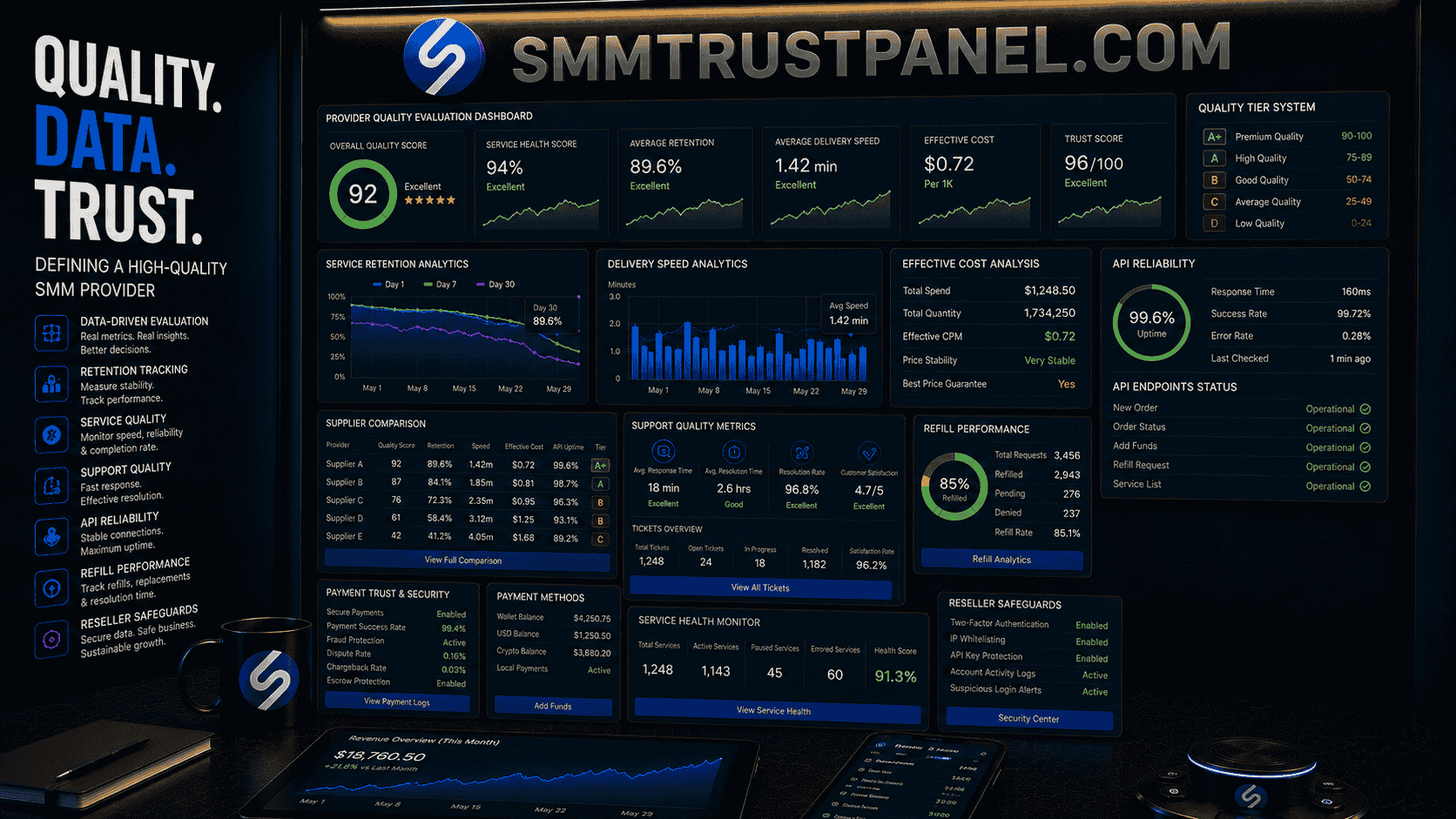
A high-quality SMM panel provider is not defined by the biggest service list, the cheapest rate, or the strongest marketing claims. Quality is measured by service accuracy, delivery consistency, retention, refill handling, pricing transparency, support quality, API stability, payment trust, and honest communication about what social media services can and cannot do.
Many users search for terms like SMM quality, SMMQuality, best SMM provider, wholesaleSMM, or even unusual phrases such as the Google SMM because they want a supplier they can trust. Some are direct buyers placing small orders. Others are agencies, freelancers, or resellers who need repeatable service performance across Instagram, YouTube, TikTok, Facebook, Telegram, X, Spotify, LinkedIn, and other platforms.
The problem is that most panels look similar at first. They may all show followers, likes, views, subscribers, members, reactions, comments, and channel services. But behind the interface, the difference can be huge. One provider may deliver quickly but drop heavily. Another may cost more but reduce support tickets. A third may offer a large API catalogue but change service IDs without warning.
A professional Smm panel should help users make better buying decisions by showing clear service details, realistic terms, useful order tracking, and responsive support. The Best smm panel for one reseller may not be the best choice for another, because quality depends on the exact platform, service type, country target, refill need, and business model.
This guide explains how to evaluate SMM provider quality using practical data instead of slogans. It also shows how SMM Trust Panel can support direct users and resellers who want a more structured approach to service selection.
Summary
A high-quality SMM provider is a panel that consistently delivers the service described, provides clear terms, maintains usable support, protects account security, processes orders transparently, and helps customers understand realistic outcomes.
The most important quality indicators are:
Accurate service descriptions
Correct target requirements
Stable delivery speed
Acceptable retention
Clear refill rules
Reasonable pricing
Low cancellation rate
Low partial-order rate
Fast support response
Secure payment handling
Reliable API performance
Honest claims
A high-quality SMM panel does not promise guaranteed sales, monetization, organic reach, rankings, virality, account approval, or permanent retention. It provides selected social media metrics according to the service description.
For direct users, quality means fewer failed orders and clearer expectations. For agencies, it means fewer client disputes. For resellers, it means stronger margins, fewer tickets, better service mapping, and more predictable fulfillment.
Why SMM Provider Quality Matters More Than Price
Cheap pricing attracts attention, but quality determines whether the customer returns.
A low-cost panel may look attractive when comparing the rate per 1,000 followers or views. However, the real cost includes drops, refunds, customer complaints, payment fees, support time, and replacement orders.
For example, two services may look similar:
| Service | Listed price | Delivered quantity | Retained after review | Refill support | Effective value |
|---|---|---|---|---|---|
| Service A | $1 per 1,000 | 10,000 | 5,500 | No refill | Weak retained value |
| Service B | $1.60 per 1,000 | 10,000 | 8,800 | Refill available | Better retained value |
The cheaper service may create more problems than it solves.
This matters to different users in different ways.
For Direct SMM Panel Users
Direct buyers want simple ordering, clear prices, and visible delivery. If the service is confusing or unstable, they may lose money on wrong orders or unsupported links.
For Businesses
Businesses care about presentation, audience signals, and campaign timing. A poor-quality provider can create delays, inconsistent delivery, and unclear reporting.
For Agencies
Agencies need predictable service delivery because clients expect explanations. If an order is partial or delayed, the agency needs accurate status information and support.
For Resellers
Resellers need the most discipline. A supplier’s failure becomes the reseller’s customer support problem. A reseller using a wholesale SMM panel should evaluate services through data before adding them to a retail catalogue.
Quality is not a luxury. It is the difference between a short-term panel and a sustainable operation.
What “SMM Quality” Really Means
SMM quality is not one single metric. It is a combination of service performance, operational transparency, supplier stability, customer experience, and risk control.
The phrase SMMQuality may appear as a brand-like search, but in practical terms, SMM quality should mean measurable performance.
Core Quality Signals
A quality provider should offer:
Clear service names
Clear platform categories
Correct minimum and maximum quantities
Public or private target instructions
Estimated start time
Estimated delivery speed
Refill information
Country-targeting notes
Order status tracking
Support system
Payment records
Dashboard security
API documentation where relevant
Quality Is Service-Specific
A panel can be strong in one category and weak in another.
For example:
Instagram likes may be stable.
YouTube views may be slow.
Telegram members may drop.
TikTok views may complete quickly.
LinkedIn services may require more testing.
Spotify services may carry higher policy risk.
That is why buyers should not judge the entire provider from one successful order.
A reliable SMM service dashboard should allow users to compare services individually rather than treating every listing as equal.
How to Evaluate an SMM Panel Provider
A proper evaluation should use a checklist, not emotion.
Step 1: Review the Service Catalogue
Look for clear categories.
A good catalogue should separate:
Instagram
TikTok
YouTube
Facebook
Telegram
X
LinkedIn
Spotify
Twitch
Website traffic
Other platforms
Within each category, services should be organized by type.
For example, Instagram should separate:
Followers
Likes
Views
Reels views
Saves
Comments
Story views
A messy catalogue can cause wrong orders.
Step 2: Read the Service Description
A service description should answer:
What does this service deliver?
What link is required?
Is the target public or private?
What is the minimum quantity?
What is the maximum quantity?
What is the start time?
What is the estimated speed?
Is refill included?
Is cancellation available?
Are there important restrictions?
If the description is vague, test carefully before ordering more.
Step 3: Test With Small Orders
A small test order gives more useful evidence than a homepage claim.
Record:
Order ID
Service ID
Starting count
Start time
Completion time
Delivered quantity
Drop after 24 hours
Drop after 7 days
Support response
Refill result
Step 4: Compare Similar Services
Do not compare unrelated services.
A basic global follower service should not be compared with a country-targeted premium follower service.
Compare services with similar:
Platform
Quantity
Country
Refill period
Delivery speed
Quality tier
Step 5: Calculate Effective Cost
Use retained quantity, not only delivered quantity.
Formula:
Effective cost per 1,000 retained units = total cost ÷ retained quantity × 1,000
Illustrative example:
Order cost: $12
Delivered quantity: 10,000
Retained quantity after review: 7,500
Effective cost:
$12 ÷ 7,500 × 1,000 = $1.60 per 1,000 retained
This calculation is more useful than the advertised price alone.
Service Accuracy and Target Compatibility
A high-quality provider should reduce wrong-order risk.
Correct Platform Matching
The order form should make it difficult to submit:
A YouTube link to an Instagram service
A profile link to a post-like service
A Telegram group link to a channel subscriber service
A TikTok video link to a profile follower service
A LinkedIn personal profile link to a Company Page service
Public and Private Target Rules
Some services work only with public targets.
Examples include:
Public Instagram profiles
Public TikTok videos
Public YouTube videos
Public Telegram channels
Public Facebook Pages
Public X posts
If a target must be public, the description should say so clearly.
Link Stability
The customer should not change the username, delete the post, make the profile private, or alter the target while the order is processing.
A quality panel should explain this before submission.
Platform-Specific Warnings
Some services require extra care.
For example:
YouTube services should not be marketed as guaranteed revenue tools.
Google review-related services should not be sold as fake customer experiences.
Spotify services should not promise royalties or chart results.
Twitch services should not be sold as guaranteed monetization eligibility.
LinkedIn services should avoid claims about guaranteed leads.
A professional service panel should separate service delivery from platform-controlled outcomes.
Delivery Speed and Timing Quality
Delivery speed is important, but speed alone does not define quality.
Start Time
Start time is the delay before delivery begins.
Service descriptions may say:
Instant
0–1 hour
1–6 hours
12–24 hours
Gradual
Slow delivery
These are usually estimates, not guaranteed exact times.
Completion Speed
Completion speed is how long it takes to deliver the full order.
A fast service may suit:
Short campaigns
Event launches
Post promotion
New content visibility
Small orders
A slower service may suit:
Large profiles
More gradual growth patterns
Premium services
Higher-retention services
Drip-Feed Delivery
Drip-feed delivery spreads quantity across time.
It may be useful for:
Large orders
New accounts
Agency campaigns
Reseller packages
Long-term campaigns
Drip-feed does not guarantee organic reach. It simply controls pacing.
Timing Records
A provider should help customers track:
Order submission time
Start time
Completion time
Refill time
Delay notices
Reliable timing reduces uncertainty.
Retention, Drops, and Refill Quality
Retention is one of the strongest indicators of provider quality.
What Retention Means
Retention refers to how much delivered activity remains after a period of time.
For example:
10,000 followers delivered
8,700 remain after seven days
Retention after seven days is 87%
Why Drops Happen
Drops can occur because:
Accounts are removed
Accounts unfollow
Platforms remove suspicious activity
Supplier routes change
The service source becomes unstable
The target changes during delivery
No provider can responsibly promise permanent retention.
Refill Terms
A refill replaces eligible drops during a defined period.
A clear refill policy should explain:
Refill period
Minimum drop required
Automatic or manual refill
Processing time
Eligibility conditions
Exclusions
What happens if the target changes
Refill Quality
A refill promise is useful only if it is actually processed.
Track:
How quickly refill requests are accepted
Whether replacement delivery starts
Whether the final count improves
Whether support explains rejected requests
A high-retention SMM panel should define the refill terms clearly instead of using vague “non-drop” language.
Pricing Transparency and Wholesale Value
A high-quality provider should make pricing understandable.
Retail Pricing
Retail customers may care about convenience and simplicity.
They usually want:
Clear rate
Easy order form
Low minimums
Simple payment
Basic support
Wholesale Pricing
Resellers need lower rates because they must cover their own costs.
A wholesaleSMM provider or wholesale SMM service should support:
API access
bulk ordering
reseller-friendly pricing
stable service IDs
order-status tracking
clear refill handling
predictable service availability
Cheap Versus Sustainable
The Cheapest smm panel is not always the strongest provider.
A service with extremely low pricing may have:
Weak retention
slow support
high partial rates
no refill
unstable suppliers
unclear descriptions
A sustainable provider balances price with support, delivery, and service quality.
Hidden Costs
Buyers should consider:
Payment fees
currency conversion
refund risk
support time
replacement orders
service drops
failed order delays
A slightly higher-priced service can be cheaper in real terms if it reduces support and refunds.
Dashboard Usability and Customer Experience
Dashboard quality affects order accuracy.
Clean Service Search
A good dashboard should allow users to find services by:
Platform
category
price
refill status
country
speed
service type
Clear New-Order Form
The order form should show:
selected service
description
link field
quantity field
minimum and maximum
price calculation
expected rules
submit button
Order History
Order history should show:
order ID
service name
link
quantity
charge
starting count
status
remaining quantity
date
Mobile Experience
Many customers place orders from phones.
A strong SMM platform dashboard should work smoothly on mobile, especially for users in mobile-first markets.
Support Access
Support should be easy to find.
Customers should not need to search through social media messages just to ask about an order.
Support Quality and Communication
Support is a major part of SMM provider quality.
What Good Support Looks Like
Good support is:
clear
relevant
polite
order-specific
timely
honest about delays
able to explain statuses
able to handle refill requests
able to escalate technical issues
Common Support Cases
Support teams often handle:
pending orders
partial delivery
canceled orders
invalid links
duplicate orders
refill requests
payment issues
API problems
service confusion
Response Time Is Not Everything
Fast but generic replies are not enough.
A useful reply should explain what happened and what the customer should do next.
Support Templates
Templates help, but they should not replace real investigation.
A quality provider should know when to escalate a problem instead of sending the same answer repeatedly.
API Reliability for Resellers
For resellers, API reliability can be more important than homepage design.
What an API Should Support
A reseller API may include:
service list
add order
order status
multiple status checks
balance check
refill request
cancel request
mass order
Stable Service IDs
Changing service IDs without notice can break reseller websites.
A quality provider should minimize sudden changes or communicate them clearly.
API Error Handling
API responses should be understandable.
A reseller needs to know whether an order failed because of:
invalid link
insufficient balance
service unavailable
quantity too low
quantity too high
duplicate order
supplier error
Balance Monitoring
Resellers should monitor supplier balance automatically.
Retail customers may have enough balance, but the upstream supplier account may not.
API Performance Metrics
Track:
response time
failed requests
status mismatch
pending duration
duplicate order rate
service-list changes
refill response
A reseller SMM panel should be judged by operational performance, not only by catalogue size.
Compliance, Trust, and Honest Claims
A high-quality SMM provider should avoid deceptive promises.
The FTC’s current guidance explains that fake indicators of social media influence can include indicators generated by bots, hijacked accounts, or activity that does not reflect a real individual’s or entity’s actual activity, opinions, findings, or experiences: FTC Consumer Reviews and Testimonials Rule guidance.
This is the only outbound authority link in this article.
Claims to Avoid
A responsible provider should not promise:
guaranteed sales
guaranteed organic reach
guaranteed monetization
guaranteed platform approval
guaranteed rankings
guaranteed virality
permanent followers
guaranteed lower ad costs
guaranteed revenue
guaranteed business leads
Review and Reputation Services
Review-related services require special care.
A provider should not sell fabricated customer experiences or fake reviews as if they came from real customers.
Platform-Controlled Outcomes
Many outcomes are controlled by platforms, not panels.
For example:
YouTube decides monetization eligibility.
Google controls review policies and Business Profile enforcement.
Meta controls ad policies and account systems.
TikTok controls platform recommendations.
Spotify controls stream validity and reporting.
A panel can deliver selected metrics, but it cannot control platform decisions.
“The Google SMM” and Search Terminology
The phrase the Google SMM is not a standard service category. Users may mean several different things:
Google review services
Google Business Profile services
Google traffic services
Google search visibility
SMM content indexed by Google
A panel they found through Google
A provider with “Google” in its marketing
These meanings are very different.
A high-quality provider should avoid confusing customers by mixing search engine optimization, review management, and social media service delivery into one unclear promise.
Google Reviews Are Not Normal SMM Metrics
Google reviews should reflect genuine customer experiences.
A review service should not create fake customer feedback, fabricated testimonials, or rating manipulation.
Google Search Rankings Are Not Guaranteed by SMM
Social media metrics do not guarantee Google rankings.
A provider should not claim that buying followers or likes will automatically improve search visibility.
Better Positioning
A safer description is:
“This service provides the selected social media metric.”
“It does not guarantee search rankings, customer reviews, or business results.”
“Review-related services must reflect genuine customer experiences.”
Clear wording protects both the provider and the buyer.
Comparing High-Quality and Low-Quality SMM Providers
| Factor | High-quality provider | Low-quality provider |
|---|---|---|
| Service descriptions | Clear and specific | Vague or misleading |
| Pricing | Transparent and sustainable | Extremely cheap without explanation |
| Delivery speed | Estimated honestly | Promised unrealistically |
| Retention | Measured and explained | Hidden or exaggerated |
| Refills | Clear terms | Confusing or ignored |
| Support | Relevant and order-specific | Generic or absent |
| API | Stable and documented | Unclear or unreliable |
| Payments | Secure and traceable | Confusing or risky |
| Claims | Realistic limitations | Guaranteed outcomes |
| Catalogue | Organized and tested | Large but messy |
| Reseller fit | Supports records and scaling | Creates hidden support costs |
A provider should be evaluated through evidence, not slogans.
Organic Growth, Paid Ads, and SMM Services
SMM services are only one part of digital growth.
| Method | Primary role | Main advantage | Main limitation |
|---|---|---|---|
| Organic content | Build genuine audience interest | Long-term trust | Slow and unpredictable |
| Paid advertising | Reach selected users through official ad systems | Targeting and measurement | Requires budget and optimization |
| Influencer campaigns | Access trusted communities | Audience relevance | Depends on creator quality |
| SMM panel services | Deliver selected visible metrics | Fast and structured | Does not guarantee genuine interest |
| Community management | Build relationships | Strong retention value | Requires ongoing work |
| Reputation management | Encourage genuine customer feedback | Builds trust | Cannot be faked responsibly |
A strong provider explains the difference.
An SMM service provider may help with visible metrics. It does not replace content, customer service, advertising, product quality, or real community building.
Product and Service Relevance for SMM Trust Panel
SMM Trust Panel provides a centralized dashboard for users who need access to social media services across different platforms.
It may be useful for:
direct buyers
freelancers
agencies
resellers
bulk buyers
international users
regional customers
API users
Realistic Use Cases
Users may use the panel to:
test service quality
order selected metrics
compare service categories
manage order records
build reseller catalogues
support multi-platform campaigns
review pricing before scaling
Practical Limitations
It cannot guarantee:
real customers
organic followers
platform monetization
viral reach
search rankings
permanent retention
business revenue
A responsible SMM Trust Panel workflow begins with small tests, clear records, and realistic expectations.
Costs, Performance, and User Experience
Quality affects cost, performance, and customer experience.
Pricing
Good pricing should reflect:
supplier cost
payment fees
service quality
refill support
platform difficulty
country targeting
support workload
reseller margin
Budgeting
A buyer should not spend the full budget on one untested service.
A safer budget process:
Test small.
Measure delivery.
Measure retention.
Review support.
Scale only if acceptable.
ROI and ROAS
SMM panel services should not be sold as guaranteed ROI or ROAS tools.
If a business tracks ROI, it should separate:
organic traffic
paid ads
influencer traffic
panel-delivered metrics
sales
leads
customer value
Dashboard Usability
A clean dashboard reduces mistakes.
Buyer Confidence
Trust improves when customers can see:
transparent pricing
clear statuses
support history
payment records
refill rules
realistic descriptions
Long-Term Value
Long-term value comes from reliable services and repeat customer trust, not only one cheap order.
Common Mistakes to Avoid
Choosing Only the Cheapest Provider
Low price without retention, support, or refill quality can create higher total cost.
Believing Every “Premium” Label
Premium should mean something measurable, such as better retention, slower delivery, stronger targeting, or refill support.
Ignoring Service Descriptions
Wrong links and unsupported targets create failed orders.
Testing Only One Platform
A provider may be strong on Instagram but weak on YouTube or Telegram.
Not Recording Starting Counts
Without starting counts, delivery disputes become harder.
Running Multiple Suppliers at Once
Overlapping orders can cause overdelivery and refill disputes.
Treating Followers as Customers
A follower, like, or view does not automatically mean a real buyer or genuine fan.
Expecting Permanent Retention
No panel can responsibly guarantee that every delivered metric remains forever.
Ignoring Compliance Risk
Fake reviews, deceptive endorsements, and fabricated social proof can create serious trust and legal issues.
Not Measuring Support Cost
A service with many tickets may be unprofitable even if the wholesale rate is low.
Expert Recommendations
Build a Testing Sheet
Track each service by:
provider
service ID
platform
cost
start time
completion time
drop rate
refill result
ticket rate
effective cost
net profit
Use a Small Approved Catalogue
Resellers should sell fewer tested services instead of thousands of unverified listings.
Evaluate Quality Monthly
Supplier routes can change.
Review performance regularly.
Create Clear Customer Descriptions
Explain:
target format
expected speed
refill eligibility
limitations
what is not guaranteed
Separate Direct and Reseller Services
Retail users need simple wording. Resellers need technical details.
Keep Backup Suppliers
A backup supplier reduces outage risk.
Monitor Effective Cost
Use retained units and support cost, not only listed price.
Protect Customer Accounts
Do not request passwords, OTP codes, recovery codes, or session files for normal public-link services.
Use SMM Trust Panel With Measured Scaling
SMM Trust Panel can support buyers and resellers who test services carefully, maintain realistic claims, and scale based on data.
Future Trends in SMM Provider Quality
Better Service Health Scores
Panels may provide more internal data about completion rate, drop rate, and refill performance.
More Transparent Quality Tiers
Providers may explain economy, standard, premium, targeted, and refill-enabled services more clearly.
Stronger Platform Enforcement
Low-quality routes may become less stable as platforms improve detection of inauthentic activity.
Improved API Monitoring
Resellers may expect stronger API documentation, error messages, balance alerts, and service-change notifications.
More Country-Specific Targeting
Demand for USA, UK, India, Pakistan, Nigeria, Bangladesh, and other country-targeted services may continue to grow.
Higher Buyer Expectations
Experienced customers will increasingly compare retention, effective cost, support, and refund risk.
More Responsible Review Services
Reputation services may shift toward genuine customer-review request systems instead of fabricated reviews.
Better Customer Education
Panels that explain limitations clearly may reduce disputes and build stronger trust.
Key Takeaways
A high-quality SMM panel provider is defined by measurable service performance, not marketing slogans.
SMM quality includes retention, delivery speed, refill handling, support, API reliability, pricing, and security.
The Best smm panel should be tested service by service.
The Cheapest smm panel is not always the lowest-cost provider after drops and support work.
WholesaleSMM buyers need API stability, service IDs, refill tools, and margin protection.
Search phrases like SMMQuality or the Google SMM should be interpreted carefully rather than forced into unclear service promises.
A Pakistan smm panel can serve worldwide buyers when services, payments, and support fit the customer’s needs.
Purchased metrics should not be presented as organic customers, guaranteed revenue, or platform approval.
Resellers should maintain testing sheets and approved service catalogues.
SMM Trust Panel can support users who scale carefully and maintain realistic expectations.
Conclusion
A high-quality SMM panel provider is not defined by the cheapest rates, the biggest catalogue, or the loudest claims. It is defined by evidence: service accuracy, retention, delivery consistency, refill handling, dashboard clarity, payment trust, support quality, API reliability, and honest communication.
Direct users need a provider that helps them order correctly and understand the limits of each service. Agencies need reliable records and customer-ready explanations. Resellers need stable supplier routes, clear service IDs, sustainable pricing, and low support burden.
A strong provider should say what a service delivers and what it does not guarantee. Followers, likes, views, subscribers, and engagement metrics can support selected presentation goals, but they cannot guarantee sales, monetization, rankings, organic reach, virality, or permanent retention.
SMM Trust Panel provides a centralized option for worldwide users, agencies, freelancers, and resellers who want structured access to social media services. Start with small tests, measure retained value, review refill rules, and scale only when the data supports it.
Whether you are comparing a global provider, a wholesale service, or a Pakistan smm panel, the best decision comes from testing, tracking, and realistic expectations.
Frequently Asked Questions
What makes an SMM panel high quality?
A high-quality SMM panel has clear service descriptions, reliable delivery, acceptable retention, defined refill terms, secure payments, responsive support, and realistic claims.
How do I measure SMM quality?
Measure SMM quality by tracking start time, completion time, delivered quantity, retained quantity, drop rate, refill success, support response, and effective cost.
What is the best SMM provider?
The best SMM provider depends on your platform, service type, budget, country, API needs, and support expectations. A Best smm panel should be tested with small orders before scaling.
Is the cheapest SMM panel always the best choice?
No. The cheapest option can become more expensive if it creates high drops, failed orders, refunds, and support problems.
What does wholesaleSMM mean?
WholesaleSMM usually refers to wholesale social media services sold at lower rates for resellers, agencies, or high-volume buyers.
What does “the Google SMM” mean?
The phrase is not a standard service category. Users may mean Google review services, Google Business Profile support, search visibility, or a panel found through Google.
Can an SMM panel guarantee sales or rankings?
No. An Smm panel cannot guarantee sales, search rankings, monetization, organic reach, virality, or permanent retention.
Can SMM Trust Panel help resellers evaluate services?
Yes. SMM Trust Panel can help resellers access services, place tests, track orders, and build a more controlled catalogue based on actual performance.