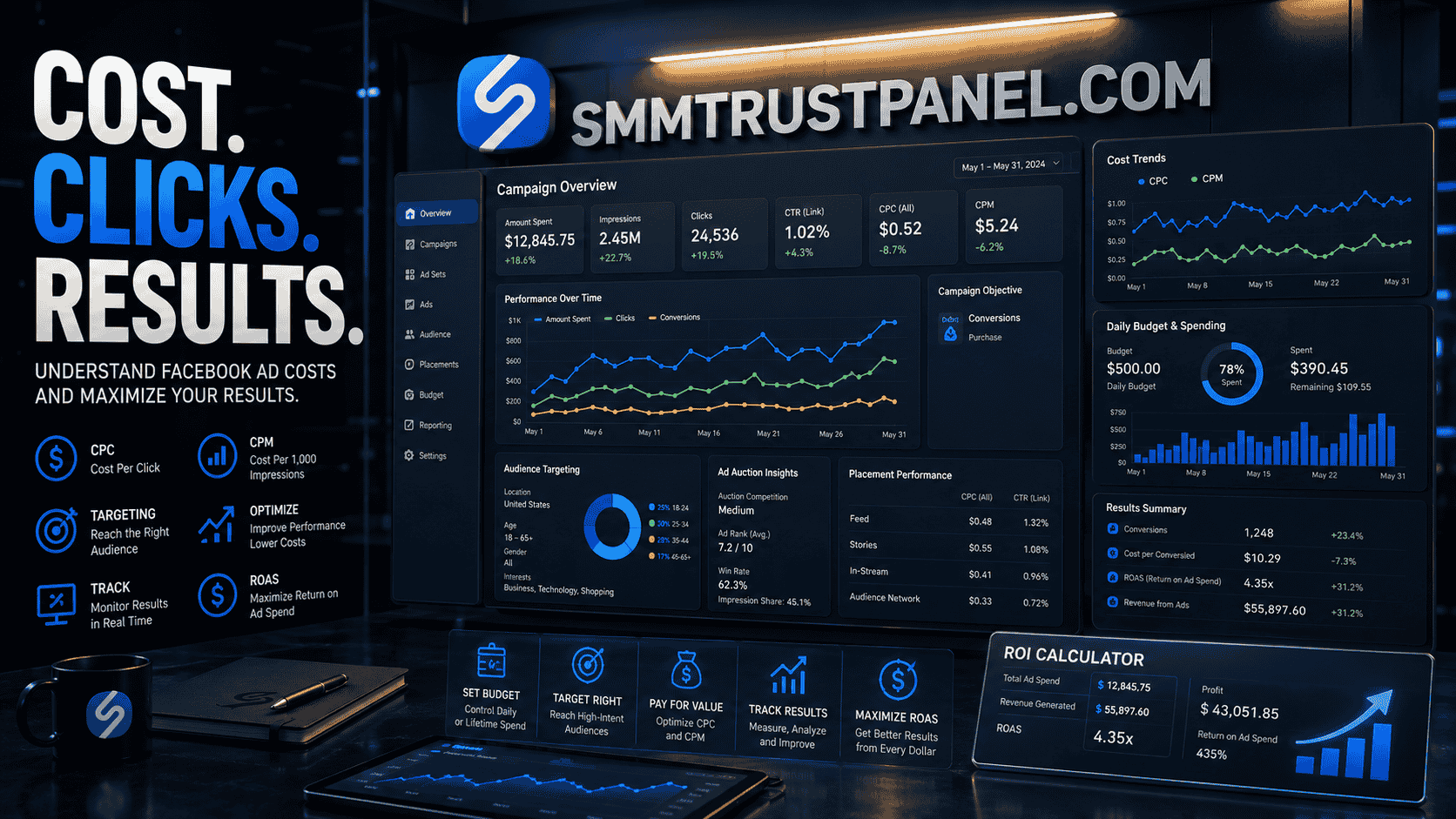
Facebook ads cost is not based on one fixed global price. The amount an advertiser pays depends on the campaign objective, target audience, country, competition, creative quality, placement, bidding strategy and the action being optimized. Two businesses can spend the same daily budget and receive very different numbers of clicks, impressions, leads or purchases.
This is why questions such as how much does it cost for Facebook ads cannot be answered with one universal figure. Facebook advertising uses an auction system. Advertisers compete for opportunities to show ads to relevant users, but the highest financial bid does not automatically win every impression. Expected performance and the likely user experience also influence delivery.
Businesses can combine official paid advertising with a broader social media strategy. A professional Smm panel may support selected social-proof and campaign-presentation goals, while advertising provides targeted distribution through Meta’s official platform. These methods perform different functions and should not be confused.
For agencies and resellers, understanding Facebook advertising cost is especially important. Clients may ask for page growth, paid reach, engagement and conversions without understanding the difference between them. A provider positioned as the Best smm panel can help fulfill selected social media services, but Ads Manager, the offer, landing page and audience strategy determine paid campaign performance.
This guide explains Facebook ad pricing, CPC, CPM, cost per result, daily and lifetime budgets, Marketplace placements and practical budgeting. It also shows how SMM Trust Panel can fit into a wider Facebook marketing system without making unsupported claims that purchased social metrics will automatically reduce advertising costs.
Summary
Facebook advertisements do not have a standard menu price. Advertisers choose how much they are willing to spend, while Meta’s auction determines where and when advertisements are delivered. The final FB ads price depends on the selected objective, audience, competition, advertisement quality, placement and optimization event.
The most common pricing measurements are CPM, CPC and cost per result. CPM represents the amount spent per 1,000 impressions. CPC represents the average amount paid for a link click or another defined click measurement. Cost per result depends on the campaign objective and may represent a lead, purchase, message, app installation or another desired action.
A small business can begin with a controlled test budget, collect enough performance data and then increase spending on the strongest advertisements. A Cheapest smm panel may help a reseller manage the expense of selected social services, but paid advertising budgets must still be planned according to conversion value and campaign economics.
Why Facebook Advertising Cost Matters
Understanding Facebook ad costs matters because the cheapest campaign is not always the most profitable campaign. A business may pay a low amount for clicks that never convert, while another may accept a higher CPC because those visitors produce valuable leads or purchases.
For example, imagine that Campaign A generates clicks for $0.30 but converts only one customer from 1,000 visits. Campaign B generates clicks for $1 but converts twenty customers from the same number of visits. Campaign B has the higher click price, yet it may generate substantially more profit.
This is why businesses should not evaluate the cost of Facebook ads through CPC alone. They should connect advertising spend to qualified traffic, leads, purchases, customer lifetime value and net profit.
Visitor experience also affects campaign economics. An attractive advertisement may earn the click, but a confusing landing page can waste the budget. Slow loading, unclear pricing, weak trust signals and complicated checkout steps can increase the real cost of every sale.
Social proof may support visitor confidence when it is relevant and proportionate. A business using a social media services panel can strengthen selected visible metrics, but it should continue improving its content, reviews, customer service and conversion process.
For SMM resellers, the practical value is even broader. A reseller may use a Pakistan smm panel for client fulfillment while running Facebook advertisements to acquire new customers. Supplier costs and advertising costs must be measured separately so the reseller understands the real profit generated by each customer.
How Facebook Ads Cost Works
Facebook and Instagram advertisements generally compete through Meta’s advertising auction. The platform evaluates eligible advertisements whenever an opportunity becomes available to display an ad to a user.
According to Meta’s official explanation of Facebook and Instagram advertising budgets and costs, advertisers control total spending through their budgets, while campaign objectives, auction conditions and bidding decisions influence the price and number of results.
This means the advertiser decides the maximum campaign or daily spend, but cannot choose a guaranteed number of results at one permanent price. The system attempts to use the available budget based on the selected objective, audience and delivery settings.
The Main Parts of the Facebook Ad Auction
The advertising auction considers more than the advertiser’s financial bid. Delivery is influenced by the value Meta expects the advertisement to create for both the advertiser and the user.
In practical terms, three central areas matter:
The advertiser’s bid: What the advertiser is willing to pay or the bidding strategy selected.
Estimated action rate: How likely the targeted user is to complete the desired action.
Ad quality: The expected quality, relevance and user experience associated with displaying the advertisement.
An advertiser with a relevant offer and effective creative may sometimes achieve stronger delivery than a competitor with a larger budget but a weaker advertisement.
That is why the question how much does it cost to advertise on FB depends partly on execution. Budget matters, but relevance, creative quality and conversion performance also affect the final result.
Why Facebook Advertising Prices Change
Facebook advertising costs can change from day to day because the auction environment changes. More competitors may enter the market, seasonal demand may rise, audiences may become saturated or an advertisement may gradually lose effectiveness.
A campaign that performs efficiently during one month may become more expensive during another. Advertisers should therefore treat FB advertising cost as a dynamic measurement rather than a permanent published rate.
Agencies using an Smm panel for Facebook services should communicate the same principle to clients. Social-service rates and advertising-auction costs are separate, and neither should be promised as permanently fixed.
Facebook CPC, CPM, CPA and Cost per Result
Understanding Facebook pricing requires knowing what each cost metric measures. Advertisers often compare numbers representing different outcomes, which can lead to poor budget decisions.
Cost per Click
CPC means cost per click. It is calculated by dividing the amount spent by the number of measured clicks.
CPC = Total advertising spend ÷ Number of clicks
If an advertiser spends $100 and receives 200 measured clicks, the average CPC is $0.50.
CPC can be useful for traffic campaigns, but it should not be confused with cost per customer. Some visitors may leave immediately, while others may convert after exploring the website.
When users search how much is Facebook ads or how much cost Facebook advertising, they are often looking for a simple CPC number. The better answer is to identify which type of click is being measured and whether that click creates business value.
Cost per 1,000 Impressions
CPM means cost per mille, or cost per 1,000 impressions. It is calculated as follows:
CPM = Total spend ÷ Impressions × 1,000
If a campaign spends $50 and receives 10,000 impressions, its CPM is $5.
CPM helps advertisers understand the cost of reaching an audience, but impressions do not guarantee attention, clicks or sales.
A business evaluating the advertising on Facebook cost for awareness should pay close attention to CPM, reach, frequency and brand-recognition indicators rather than judging the campaign solely by website clicks.
Cost per Result
Cost per result depends on the campaign objective. A result may be:
A website purchase
A lead-form submission
A Messenger or WhatsApp conversation
A landing-page view
An app installation
A video view
A page-engagement action
The formula is:
Cost per result = Total spend ÷ Number of results
For many businesses, cost per result is more useful than CPC because it connects spending to the campaign’s selected objective.
Cost per Acquisition
CPA commonly represents the cost of acquiring one customer or another commercially valuable conversion.
If a company spends $1,000 and obtains twenty paying customers, its CPA is $50.
Whether $50 is acceptable depends on the revenue and profit generated by each customer. A business earning $500 in gross profit per customer may accept that CPA, while a company earning $20 cannot.
A reseller using SMM Trust Panel should compare customer-acquisition cost with average deposits, order margins and repeat purchases. This is more useful than focusing only on the initial FB cost.
Return on Ad Spend
ROAS measures the revenue generated for each unit of advertising spend.
ROAS = Revenue attributed to ads ÷ Advertising spend
If a campaign spends $500 and produces $2,000 in attributed revenue, its ROAS is 4, often described as 4:1.
ROAS should not be confused with profit. Product costs, refunds, payment processing, customer service and operating expenses still need to be deducted.
What Determines Facebook Advertising Cost?
Campaign Objective
The chosen objective tells Meta what type of result the advertiser wants. Reaching people, generating video views, receiving leads and producing purchases require different optimization systems.
A simple engagement action may cost less than a completed sale, but the cheaper action may also have less commercial value. This is why how much is Facebook advertising depends heavily on the outcome being requested.
A Best smm panel can provide selected engagement services, while a conversion advertisement is designed to find users likely to complete a defined business action. The two services should not be measured as though they are identical.
Audience Location
Competition and advertiser spending differ between countries and regions. Campaigns targeting the United States, United Kingdom, Western Europe or other highly competitive markets may face different auction conditions from campaigns targeting Pakistan, India, Southeast Asia, Africa or Latin America.
This does not automatically mean one region is better. The correct market is the market where the business can realistically sell its offer.
A worldwide Pakistan smm panel may serve international customers, but advertising campaigns should still be separated by language, geography, purchasing power and customer intent.
Audience Size and Specificity
A very narrow audience may provide limited delivery opportunities. An extremely broad audience may contain many people who are not relevant to the offer.
Advertisers should avoid adding targeting restrictions merely because the options exist. The audience should be specific enough to represent likely customers but broad enough for the system to learn and find opportunities.
Advertiser Competition
More competition for the same users can increase Facebook marketing cost. Competition may be higher during holidays, major sales events, elections, product launches or industry-specific peak periods.
A business should plan additional testing room during competitive periods instead of assuming that previous campaign costs will remain unchanged.
Creative Quality
The image, video, headline, primary text and call to action affect whether users pay attention and act. Weak creative can increase costs because the advertisement receives fewer useful responses.
Good creative communicates the offer quickly. It should show the problem, benefit, proof and next step without requiring the viewer to interpret a complicated message.
Companies may use a social media growth panel to support visible activity, but effective advertising still requires creative that fits the audience.
Offer Quality
A strong advertisement cannot permanently rescue a weak offer. Price, product-market fit, guarantee, delivery, reputation and customer service all influence conversion.
If many people click but very few buy, the problem may not be the cost for Facebook. The landing page, pricing or offer may require improvement.
Landing-Page Experience
The landing page should load quickly, match the message presented in the advertisement and make the next step obvious. Unexpected pricing, broken forms and poor mobile design can waste paid traffic.
A business can reduce wasted advertising spend by reviewing the complete path from advertisement to checkout rather than optimizing only the ad itself.
Placement
Meta can distribute advertisements across several placements, including Facebook Feed, Instagram Feed, Stories, Reels, Messenger and other eligible placements, depending on campaign settings and availability.
Each placement may produce a different price and type of interaction. Automated placement selection can give the delivery system flexibility, while manual placement may be appropriate when the creative or business requirement is highly specific.
Seasonality and Timing
Facebook ad prices can rise when many advertisers compete for user attention. Prices may also decrease when competition becomes weaker.
The day of the week and hour of the day can affect individual campaign results, but businesses should base scheduling decisions on their own conversion data rather than broad assumptions.
Account and Campaign History
A campaign needs enough reliable data to improve delivery. Constantly rebuilding campaigns, changing major settings or dividing small budgets across too many ad sets can slow the learning process.
An agency using an SMM reseller dashboard should also maintain accurate advertising records so promotional results are not confused with panel orders.
How Much Should You Budget for Facebook Ads?
The correct budget depends on the objective, market, expected conversion rate, customer value and the amount of data required. There is no universal daily amount that works for every business.
Instead of asking only how much is it to advertise on Facebook, begin with four practical questions:
What result is the campaign expected to generate?
How much is that result worth to the business?
What is the maximum acceptable cost per result?
How many results are needed to evaluate performance?
A Simple Budget Formula
A useful planning formula is:
Daily budget = Target cost per result × Desired daily results
If the acceptable cost per lead is $10 and the business wants five leads per day, the starting daily budget would be approximately $50.
This is a planning calculation, not a guarantee that the campaign will produce exactly five leads every day.
Small Test Budget
A small local business or new advertiser may begin with a controlled daily budget that it can afford to lose during the learning stage. The objective is not immediate scale. It is to discover which audience, creative and offer generate meaningful results.
For illustration, a business might test one focused campaign at $10 to $30 per day rather than dividing the same amount across many underfunded ad sets. The right amount still depends on expected result costs in the selected market.
A company using a Cheapest smm panel should keep panel spending and advertising-test budgets in separate records. This makes campaign profitability easier to evaluate.
Moderate Lead-Generation Budget
A company with a proven offer may use a larger daily budget to generate enough leads for comparison. For illustration, $30 to $100 per day may provide more testing room than a very small campaign, although competitive industries may require substantially more.
The advertiser should monitor lead quality rather than lead quantity alone. Cheap leads that never respond or complete a purchase are not necessarily valuable.
E-Commerce Advertising Budget
E-commerce campaigns generally need enough budget to gather purchase, checkout and product-view data. The starting amount should reflect product price, expected conversion rate, profit margin and acceptable customer-acquisition cost.
A store selling a $20 product cannot usually use the same acquisition target as a business selling a $2,000 professional service.
Agency and Reseller Budget
An SMM reseller should estimate expected customer lifetime value rather than judging the campaign only through the first deposit. A customer acquired for $30 may still be profitable if that customer places regular orders over several months.
Resellers working with SMM Trust Panel can compare paid acquisition costs with deposits, repeat orders and gross margins to determine a sustainable advertising budget.
Daily Budgets Versus Lifetime Budgets
Daily Budget
A daily budget represents the average amount the advertiser is willing to spend on a campaign or ad set each day. Actual daily spending can vary as the system searches for advertising opportunities, while total spending is managed around the selected budget rules.
Daily budgets are useful for ongoing campaigns and situations where the advertiser wants flexible control over recurring spending.
Lifetime Budget
A lifetime budget represents the total amount available during a defined campaign schedule.
This can be useful for an event, limited promotion or fixed campaign period. The system can distribute spending across the schedule according to the opportunities available on different days.
Which Budget Type Is Better?
Neither option is always superior. Daily budgets provide straightforward ongoing control. Lifetime budgets can be useful when the advertiser knows the campaign’s total allocation and ending date.
The important issue is not only the budget type. It is whether the campaign has enough money and time to gather useful performance information.
An advertiser comparing FB advertising price should review the complete campaign period rather than judging performance after a few hours.
Facebook Ad Pricing by Campaign Goal
Awareness and Reach Campaigns
Awareness campaigns are designed to expose a message to relevant users. Their performance is often evaluated through CPM, reach, frequency and brand-awareness measurements.
The cost per impression may appear low compared with lead or sales campaigns, but awareness campaigns do not guarantee immediate revenue.
Traffic Campaigns
Traffic campaigns focus on actions such as link clicks or landing-page views. Advertisers commonly evaluate CPC and cost per landing-page view.
When considering Facebook ads price for traffic, prioritize landing-page visits and on-site behavior rather than treating every click as equally valuable.
Engagement Campaigns
Engagement campaigns may optimize for reactions, comments, shares, video views or other interactions.
They can support social proof and content distribution, but engagement does not necessarily translate into purchases. Businesses may combine official engagement advertising with proportionate services from an Smm panel, while reporting the two sources separately.
Lead Campaigns
Lead campaigns can use instant forms, website forms, telephone calls or messaging experiences. Cost per lead is important, but lead quality determines the real value.
A longer qualifying form may produce fewer leads while improving relevance. A shorter form may reduce the displayed cost but increase low-quality submissions.
Sales Campaigns
Sales campaigns optimize toward actions such as purchases and other high-value conversions. They commonly require dependable tracking, sufficient event data and a convincing offer.
The advertiser should evaluate cost per purchase, revenue, ROAS and gross profit rather than CPC alone.
Message Campaigns
Message-focused campaigns can encourage users to begin conversations through Messenger, Instagram Direct or WhatsApp, depending on availability and settings.
The business needs a fast response system. Paying for conversations provides limited value when messages remain unanswered.
App Promotion Campaigns
App campaigns may optimize for installations or in-app actions. The cost depends on app category, device, country, competition and selected optimization event.
The advertiser should compare installation cost with activation, retention and long-term customer value.
Common Facebook Advertising Price Questions
How Much Are Ads on Facebook?
The answer depends on the result being purchased through the advertising auction. Impressions, clicks, leads and purchases have different values and costs.
Someone asking how much are ads on Facebook should first identify the campaign objective, country, audience and acceptable cost per result.
How Much Does an Ad on Facebook Cost?
An individual advertisement does not have one permanent listing price. The advertiser sets a budget, and delivery occurs through the auction.
The question how much does an ad on Facebook cost is best answered through the planned budget, actual CPM, CPC and conversion cost after a suitable test.
What Is the Average Cost to Advertise on Facebook?
There is no single worldwide average that applies to every objective and industry. Published benchmarks vary because they use different countries, dates, placements, objectives and advertiser samples.
The most useful average cost to advertise on Facebook is the advertiser’s own historical cost for a qualified business result.
What Is Facebook Paid Promotion Cost?
Facebook paid promotion cost depends on the amount selected for boosting or advertising, the audience and the desired duration. Boosted posts and Ads Manager campaigns both use paid distribution, but Ads Manager generally offers broader campaign controls.
How Much Does It Cost to Put Ads on Facebook?
The advertiser chooses the available budget. The auction determines how many results that budget can produce.
Therefore, how much does it cost to put ads on Facebook should be answered through an affordable test amount and a maximum acceptable cost per business result.
What Is Facebook Marketplace Ads Cost?
Facebook Marketplace ads cost does not normally operate as one separate fixed Marketplace fee. Marketplace can function as an available advertising placement, and cost is influenced by the broader campaign auction, targeting, objective and competition.
What Do “FB Ads Pricing” and “Facebook Advertising Prices” Mean?
Terms such as FB ads pricing, Facebook advertising prices, Facebook ads prices and price for Facebook ads all refer to the amount advertisers spend to obtain impressions or campaign results through Meta’s advertising system.
Similarly, searches such as how much do FB ads cost, Facebook paid ads cost and Facebook paid advertising cost express the same underlying need: understanding how much budget is required for a useful result.
What Is Meta Advertising Cost?
Meta advertising cost may refer to paid campaigns distributed across Facebook, Instagram, Messenger and other eligible Meta placements.
The broader phrase Meta advertising costs can also include creative production, agency fees, tracking tools, landing-page development and internal management—not only the media spend shown in Ads Manager.
What Do Other Search Variations Mean?
Search phrases such as cost Facebook advertising, Facebook marketing rates, Facebook ad pricing, Facebook advertising cost and FB ads cost all point toward the same broad topic.
The awkward query how much cost Facebook advertising means the user wants an estimate of total campaign spending. Likewise, Facebook advertising prices, FB advertising cost and Facebook ad prices refer to auction-based campaign expenses rather than a universal fixed rate.
Advertisers should translate all these questions into one practical calculation: how much can the business afford to pay for a qualified result?
Facebook Ads Versus SMM Panel Services
Facebook advertisements and SMM panel services are not direct substitutes. Each solves a different marketing problem.
| Method | Main purpose | Targeting | Pricing model | Typical measurement |
|---|---|---|---|---|
| Facebook advertising | Official paid distribution and conversion optimization | Audience and algorithmic targeting | Auction-based media spend | CPM, CPC, leads, purchases and ROAS |
| SMM panel services | Selected social metrics and reseller fulfillment | Depends on the selected service | Listed service rate | Followers, likes, views or another delivered quantity |
| Organic content | Audience development and trust | Based on relevance and platform distribution | Production and management expense | Reach, engagement, traffic and conversions |
A business can use a social media marketing panel for suitable social-proof objectives and Ads Manager for targeted traffic or conversions.
However, purchasing followers or engagement does not automatically reduce the Facebook marketing cost. Advertising-auction performance depends on the campaign’s audience, creative, offer, optimization and expected results.
A responsible Best smm panel should not promise guaranteed CPC reductions, advertising approval or sales.
When Facebook Advertising Is the Better Tool
Facebook advertising is generally the more appropriate option when the objective is:
Reaching a defined audience
Generating qualified leads
Producing online purchases
Retargeting website visitors
Promoting an application
Testing offers and creative
When an SMM Panel May Be Relevant
An Smm panel may be considered for:
Supporting visible page presentation
Fulfilling a clearly described reseller package
Testing selected social services
Adding proportionate engagement to a broader campaign
Managing services across several social platforms
Agencies using SMM Trust Panel should keep panel orders, organic results and paid advertising performance in separate reports.
How to Reduce Facebook Advertising Costs Responsibly
Improve the Offer Before Increasing the Budget
Advertising amplifies the offer that already exists. If visitors reject the price, product or terms, spending more will generally increase losses.
Interview customers, study objections and clarify the value before attempting to scale.
Test Several Creative Angles
One advertisement rarely represents the entire market. Test different hooks, demonstrations, testimonials, problem statements and creative formats.
Do not change every variable at the same time. A structured test makes it easier to understand why performance improved or declined.
Match the Advertisement to the Landing Page
The wording, product and promise on the landing page should match the advertisement. Strong message consistency reduces confusion after the click.
Measure Qualified Results
A campaign may produce cheap clicks and expensive customers. Optimize toward the action closest to business value when sufficient data and tracking are available.
A reseller using a Cheapest smm panel should evaluate paid campaigns through registrations, deposits and repeat purchases rather than clicks alone.
Avoid Excessive Audience Fragmentation
Dividing a limited budget across too many similar ad sets can prevent each one from gathering sufficient information. Consolidation may improve learning and simplify analysis.
Refresh Tired Creative
An advertisement may become less effective after repeated exposure. Rising frequency, declining click-through rate and increasing cost per result may indicate creative fatigue.
Improve Mobile Performance
Many Facebook users browse on mobile devices. Landing pages should load quickly, display clearly and make forms or checkout easy to complete.
Use Retargeting Thoughtfully
Retargeting can reach people who visited the website, viewed products or engaged with content. These audiences may already know the brand, but the message should reflect their stage in the customer journey.
A Pakistan smm panel can support worldwide service fulfillment, while retargeting helps bring interested visitors back to the business.
Common Mistakes to Avoid
Judging the Campaign Only by CPC
A low CPC is not useful when the traffic does not convert. Track the cost of qualified leads, paying customers and profitable purchases.
Starting Without Conversion Tracking
Without dependable tracking, the advertiser cannot identify which campaigns generate meaningful business results.
Changing Campaigns Too Frequently
Constant edits make results difficult to interpret and may prevent the system from gathering stable data.
Using One Creative for Every Audience
Different audiences may respond to different problems, benefits and evidence. Adapt the message while maintaining consistent brand positioning.
Sending Every Campaign to the Homepage
A focused landing page commonly provides a clearer path than a general homepage containing several competing offers.
Ignoring the Follow-Up Process
Lead advertisements are ineffective when no one contacts the leads. Message advertisements waste money when replies arrive hours or days later.
Mixing Paid Ads With Purchased Engagement Data
Keep Facebook Ads Manager results separate from services ordered through an SMM panel dashboard. Mixing the sources makes performance analysis unreliable.
Scaling Before the Offer Is Proven
Increasing the budget on an unprofitable campaign usually increases the loss. Confirm that the campaign economics work before scaling aggressively.
Copying Another Business’s Budget
Another advertiser may have a different conversion rate, customer value, country, profit margin and sales process. Its budget may be unsuitable for your business.
Expert Recommendations
Set a Maximum Acceptable Cost per Result
Calculate the highest amount the business can pay for a lead or customer while remaining profitable. Use this as a decision boundary rather than chasing the lowest visible CPC.
Create a Testing Budget and a Scaling Budget
Testing funds should be treated as research expenditure. Scaling funds should be allocated only after a campaign demonstrates repeatable performance.
Review the Full Conversion Funnel
Separate the process into impression, click, landing-page visit, lead, sale and repeat purchase. Weak performance at any stage can increase the total acquisition cost.
Use Clear Naming and Reporting
Campaign names should identify the market, objective, audience and creative. Good organization reduces reporting and analysis errors.
Agencies working with SMM Trust Panel should maintain separate records for panel fulfillment and paid-ad management.
Evaluate Profit, Not Only Revenue
A strong ROAS can still hide weak profit when product costs, refunds and customer-support expenses are high.
Test One Major Variable at a Time
Changing the audience, creative, offer and landing page simultaneously makes it difficult to identify what caused the result.
Scale Gradually
Sudden budget increases can alter delivery behavior. Increase spending carefully while monitoring cost per result and conversion quality.
Use Social Proof Honestly
Testimonials, reviews and visible activity can support credibility, but they should not mislead customers. Services from a Best smm panel should be used with realistic expectations and responsible marketing.
Future Trends in Facebook Advertising Costs
Greater Use of Automation
Meta continues expanding automated audience, placement, budget and creative systems. Advertisers will spend less time controlling every individual setting and more time providing strong creative, conversion data and business inputs.
Creative Will Become a Larger Competitive Advantage
As targeting becomes more automated, creative quality may become even more important. Businesses will need a regular supply of useful videos, images, demonstrations and customer stories.
First-Party Data Will Matter More
Businesses that understand their customers and maintain accurate consent-based data will be better positioned to build relevant campaigns and measure outcomes.
Profit-Based Measurement Will Replace Surface Metrics
Advertisers will increasingly evaluate contribution margin, repeat purchases and customer lifetime value rather than celebrating low CPC alone.
Messaging-Based Commerce Will Grow
More businesses will use Messenger, Instagram Direct and WhatsApp as sales and customer-support channels. Response speed and conversation quality will influence campaign profitability.
Social Proof and Paid Distribution Will Remain Separate Tools
Businesses may continue using an Smm panel for selected presentation goals and Facebook ads for targeted customer acquisition. Clear reporting will become more important as marketing systems become more complex.
Worldwide Cost Differences Will Continue
Advertiser competition, customer value and purchasing power vary by country. A worldwide campaign should not use one cost expectation for every market.
An international reseller using a Pakistan smm panel should calculate separate advertising economics for each target region.
Key Takeaways
Facebook ads cost is determined through a dynamic auction rather than one fixed worldwide price.
Advertisers control total spending through budgets, but the number and cost of results depend on campaign performance.
CPM measures spending per 1,000 impressions, while CPC measures the average cost of clicks.
Cost per lead, purchase and customer is often more useful than CPC alone.
Audience, objective, competition, creative, offer and landing-page experience all influence cost.
An Smm panel provides selected social media services, while Facebook advertising provides official targeted distribution.
Using a Cheapest smm panel does not automatically reduce paid advertising costs.
Start with a controlled testing budget, define the maximum acceptable cost per result and scale gradually.
Businesses should evaluate profit, lead quality and customer lifetime value instead of surface metrics alone.
SMM Trust Panel can support broader Facebook marketing and reseller fulfillment when panel services and advertising results are measured separately.
Conclusion
Facebook ads cost cannot be reduced to one permanent CPC, CPM or daily price. Meta advertising operates through an auction, and campaign expenses change according to the selected objective, audience, competition, creative, offer and desired result.
The best way to answer how much does it cost for Facebook ads is to begin with business economics. Determine the value of a lead or customer, set a maximum acceptable acquisition cost and choose a testing budget that can collect useful data without creating unacceptable risk.
Advertisers should compare more than FB ads price. A low CPC can hide weak traffic, while a higher CPC can still be profitable when the visitors convert. Cost per qualified result and net profit provide a clearer picture.
Businesses can use a professional Smm panel to support selected social-proof or reseller-fulfillment goals while using official Facebook advertising for audience targeting, traffic, leads and sales.
SMM Trust Panel gives worldwide users and resellers access to organized social media services from one dashboard. These services should complement genuine content and responsible advertising rather than being presented as guaranteed solutions for lower CPC or automatic sales.
A structured approach produces the strongest decisions: test carefully, measure qualified results, improve the funnel and scale only when the campaign economics make sense. That principle applies whether the advertiser is a local company, global e-commerce brand, agency or reseller using a Pakistan smm panel.
Frequently Asked Questions
How Much Do Facebook Ads Cost?
Facebook ads cost does not have one fixed rate. Advertisers set their budgets, while the auction determines delivery and cost per result based on the audience, objective, competition and advertisement quality.
How Much Does It Cost to Advertise on Facebook Per Day?
The advertiser chooses the daily budget. A small business may begin with a controlled test amount, while a proven campaign may use a much larger budget. The correct amount depends on the expected cost and value of the desired result.
What Is a Good Facebook Ads Budget?
A good budget is large enough to collect useful information but small enough that the business can tolerate the testing risk. One planning method is to multiply the target cost per result by the number of desired daily results.
What Is the Difference Between CPC and CPM?
CPC is the average cost of measured clicks. CPM is the cost per 1,000 impressions. CPC is useful for traffic evaluation, while CPM explains the cost of audience exposure.
Are Facebook Ads More Effective Than SMM Panel Services?
They serve different purposes. Facebook advertisements provide official targeted distribution and conversion optimization. An Smm panel supplies selected social metrics or reseller services. One is not a direct replacement for the other.
Can Buying Facebook Followers Lower My Advertising Cost?
There is no guarantee that buying followers will reduce CPC, CPM or cost per result. Advertising performance depends on the campaign’s auction signals, creative, audience, offer and conversion process.
How Can I Reduce Facebook Ad Costs?
Improve the offer, test stronger creative, use relevant targeting, optimize the landing page, measure qualified conversions and refresh advertisements when performance declines. A Best smm panel may support broader social proof, but it cannot replace campaign optimization.
What Is Facebook Marketplace Ads Cost?
Marketplace advertising does not normally have one universal placement fee. Cost depends on the campaign objective, audience, competition and auction delivery when Marketplace is used as an eligible placement.